Quick answer: FDA has approved no BPC-157 product, and we could not verify any lawful retail route to it. FDA's page lists it as a substance that was nominated for compounding and withdrawn, and FDA staff's briefing dated 2026-05-11 says the criteria weigh against adding it to the 503A bulks list. Products sold online as "research" BPC-157 are the ones FDA's warning letters address. Whoosh does not offer it.
- FDA status
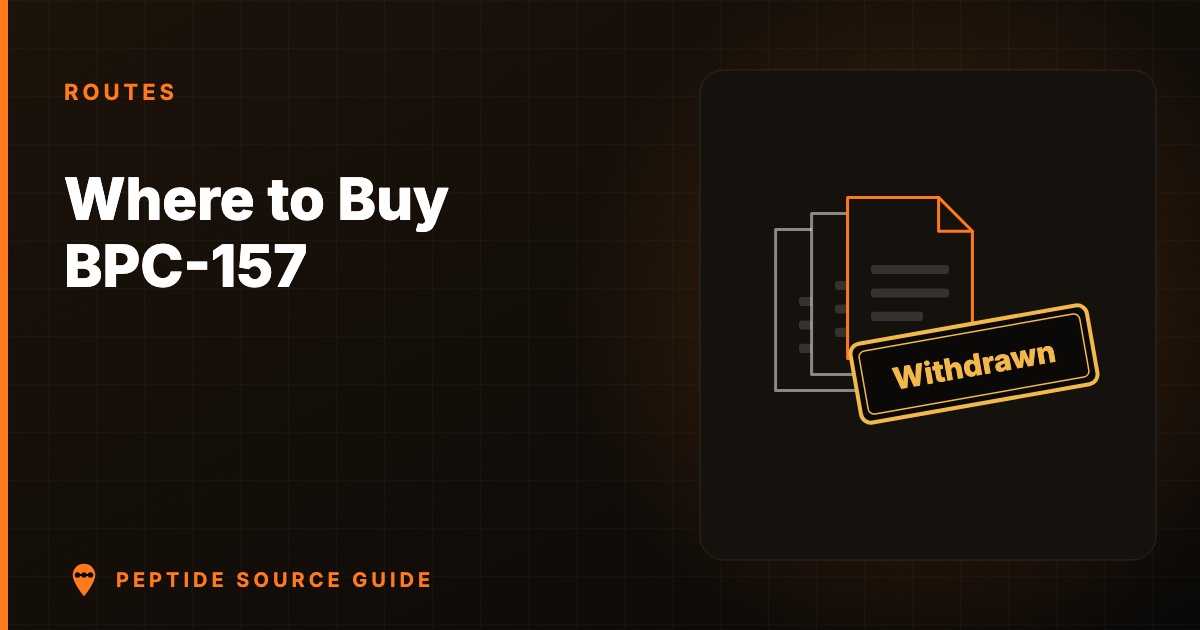
No FDA-approved product. Listed on FDA's safety-risks page as nominated but withdrawn (previously Category 2), with FDA safety text.
- Lawful route
None we could confirm. Only a prescriber's own judgment or a registered trial might apply.
- Brand or compounded
No brand product. Any compounded version is not FDA-approved.
- Whoosh offers this
No
As of 2026-10-07.
Searching for where to buy BPC-157 turns up many sellers, and this page does not point to any of them. It reports what FDA's own documents say about the substance, what that means for the routes people ask about, and what we could not confirm. A partner relationship funds this site, and that partner does not sell BPC-157; no link here goes to a seller. BPC-157 is the subject of an active FDA process, so statuses can change; this page is dated 2026-10-07.
What BPC-157 is
BPC-157 is a short chain of amino acids. An FDA briefing document describes it as reported to be made up of 15 amino acids. It is not a hormone or a vitamin, and no approved drug contains it. The same briefing says it is not a component of an FDA-approved drug, and that in the United States it is marketed as an ingredient in dietary supplement products formulated as oral capsules and tablets. That is FDA describing the market, not endorsing it. For background on the word "peptide," see what is peptide therapy.
What FDA's pages say
The safety-risks page. FDA's page on bulk drug substances that may present significant safety risks (current as of 2026-04-22) carries BPC-157 in a table of substances nominated for compounding that were withdrawn by the nominators. FDA introduces that table as a list of substances previously in Category 2. We do not write that BPC-157 is in Category 2 today, because FDA's page says otherwise, and we do not write that it is banned. The page still prints FDA's safety text. FDA says compounded drugs containing BPC-157 may pose a risk of immunogenicity for certain routes, and may have complexities with peptide-related impurities and characterization of the active ingredient. FDA also says it "lacks sufficient information to know whether the drug would cause harm" in humans.
The staff briefing. FDA staff wrote a briefing document dated 2026-05-11 for the Pharmacy Compounding Advisory Committee meeting held on 2026-07-23 and 2026-07-24. It evaluated BPC-157 for one use only, ulcerative colitis. Its conclusions, as written by FDA staff:
- It found "a lack of evidence to support the effectiveness" for that use, with one small trial reported only as a meeting abstract.
- It found "insufficient clinical safety information," and no human studies of several routes, including injection under the skin.
- It said reports to FDA's adverse-event system included injection site reaction, shortness of breath, and skin and gum darkening, and that it was unclear whether BPC-157 caused them.
- It said a balancing of the criteria "weighs against" placing BPC-157 on the 503A bulks list, and proposed not adding it.
A briefing is staff's recommendation. FDA's meeting page says advisory committees make non-binding recommendations. We did not find FDA's published outcome as of 2026-10-07, and we do not report the committee's vote, because the only accounts we found were secondary. FDA's category document, updated 2026-05-14, does not list BPC-157 in any category. If FDA publishes a decision, the status could change, and this page would be updated with a new date.
No approved product. The briefing found no approved product in New Zealand, no BPC-157 monograph in the European, Japanese or International Pharmacopoeia, and no approved product in any country it searched. The briefing is the source for these statements.
Anti-doping. The briefing says BPC-157 appears on the World Anti-Doping Agency's prohibited list under non-approved substances. We read WADA's 2026 Prohibited List in a copy hosted by the International Testing Agency, and it names BPC-157 in that class, which applies at all times. Athletes subject to testing should check the current list and USADA's guidance before using any product containing it.
What lawful routes exist
We could not verify a retail route. Here is each route people ask about, and what we found.
- A prescription from your own prescriber. Compounding is regulated under federal and state law. FDA's pages say compounded drugs are not FDA-approved and that FDA does not review them for safety, effectiveness or quality before they are marketed. Whether a given pharmacy may lawfully compound BPC-157 right now was not stated in any FDA sentence we read, so we cannot say. A prescriber and a state-licensed pharmacy can tell you in writing.
- A clinical trial. Research use under a registered study is a different thing from buying a product. You can search a trial registry such as ClinicalTrials.gov for studies and read who is running them. We make no claim that any trial is open to you.
- A supplement. FDA's briefing says BPC-157 is marketed in supplements. We did not find FDA saying such products are lawful or safe, and the briefing's statement is about the market, not a ruling.
- A "research" website. This is the route most searches lead to, and it is the one FDA's letters address.
The research-use-only risk
Sellers often print "research use only" or "not for human consumption" on a vial. FDA's warning letters, such as the one dated 2026-03-31, say that despite those labels, evidence from a seller's own website can establish that a product is "intended to be drugs for human use." FDA calls such products unapproved new drugs. The label wording does not change what the product is. FDA's GLP-1 page (current as of 2026-10-01) also warns consumers not to purchase products falsely labeled this way.
That matters for you because a product with no prescriber, no state-licensed pharmacy and no label has no accountability. Nobody has to tell you what is in the vial. FDA says medicines from unsafe sources may contain too much or too little of an ingredient, or the wrong ingredient. On personal importation, FDA says individuals bringing drugs into the US for their own use will usually be breaking the law. See research peptides explained and is it legal to buy peptides online.
Our five seller criteria (listed in how to choose a peptide company) cannot be met by a vial with a research label. A seller that prints "research use only" on the product fails the fifth by definition. Criteria 3 to 5 are our selection from FDA's pages, not an FDA checklist.
Whoosh does not offer this
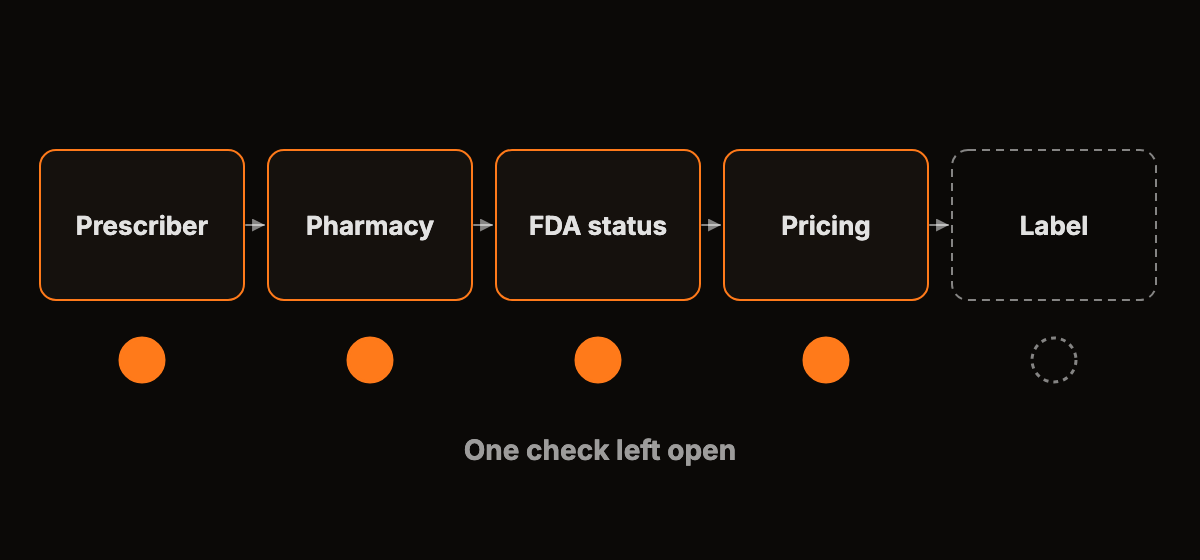
Whoosh does not offer BPC-157. As stated by Whoosh (read 2026-10-07), it offers compounded sermorelin, semaglutide and tirzepatide, plus NAD+, glutathione and a topical GHK-Cu product; it does not offer BPC-157, CJC-1295, ipamorelin, tesamorelin or retatrutide. Compounded medications are not FDA-approved. Read the Whoosh Wellness review for what it does offer. There is no button on this page because there is nothing here to start.
What to ask a prescriber
If you are weighing BPC-157 anyway, ask a licensed prescriber: what FDA status does this product have, what does FDA say about its risks, and is there an approved drug for the condition I am concerned about? FDA's briefing noted that approved drugs exist for ulcerative colitis, the use it evaluated. Our safety guide explains what an official label does and does not tell you.
Sources
- FDA: Certain bulk drug substances for use in compounding that may present significant safety risks page current as of 2026-04-22, read 2026-10-07
- FDA: Briefing document on BPC-157 for the Pharmacy Compounding Advisory Committee memo dated 2026-05-11, read 2026-10-07
- FDA: July 23-24, 2026 meeting of the Pharmacy Compounding Advisory Committee page current as of 2026-08-06, read 2026-10-07
- FDA: Bulk drug substances used in compounding under section 503A category document updated 2026-05-14, read 2026-10-07
- FDA warning letter dated 2026-03-31 page current as of 2026-04-07, read 2026-10-07
- FDA: FDA's concerns with unapproved GLP-1 drugs used for weight loss page current as of 2026-10-01, read 2026-10-07
- FDA: Personal importation page current as of 2025-08-18, read 2026-10-07
FAQ
Is BPC-157 FDA-approved?
No. FDA's briefing says it is not a component of an FDA-approved drug, and we found no approved BPC-157 product.
Is BPC-157 legal to buy?
We cannot give a yes or no. Products sold as "research" BPC-157 are the kind FDA's warning letters call unapproved new drugs, and FDA says personal importation is illegal in most circumstances. Whether a pharmacy may compound it was not stated in any FDA sentence we read.
Did FDA decide to allow BPC-157 in compounding?
We did not find FDA's published outcome as of 2026-10-07. FDA staff recommended against adding it to the 503A bulks list in a briefing dated 2026-05-11, and an advisory committee met on 2026-07-23 and 2026-07-24. An advisory committee's recommendation is non-binding.
Is BPC-157 banned in sports?
WADA's 2026 Prohibited List names BPC-157 under non-approved substances, which are prohibited at all times. Athletes should check the current list.
Can Whoosh provide BPC-157?
No. As stated by Whoosh (read 2026-10-07), it does not offer BPC-157. See the review linked above.
Where can I find studies about BPC-157?
PubMed indexes published studies, and ClinicalTrials.gov lists registered trials. FDA's briefing describes the human evidence it found as limited.
Not medical advice. See the medical disclaimer.