Quick answer: In the USA, the lawful way to buy a peptide online is a prescription from a licensed clinician, filled by a state-licensed pharmacy. Most peptides sold on forums have no FDA approval, and compounded medications are not FDA-approved. FDA's warning letters say a "research use only" label does not change what a product is intended for. Judge any seller against the five checks below.
Three takeaways
- The lawful route is a prescription filled by a licensed pharmacy, and a licensed physician decides whether a prescription is appropriate.
- A "research use only" label is not a shortcut: FDA has told sellers in writing that such products are unapproved drugs.
- Any seller, including the one we feature, can be checked against five criteria you can test yourself.
Some links on this page are affiliate links, which means we may earn a commission if you use them, at no extra cost to you, and the featured service describes its own process. We are an editorial team that reads FDA pages and seller pages and writes down what they say, with dates.
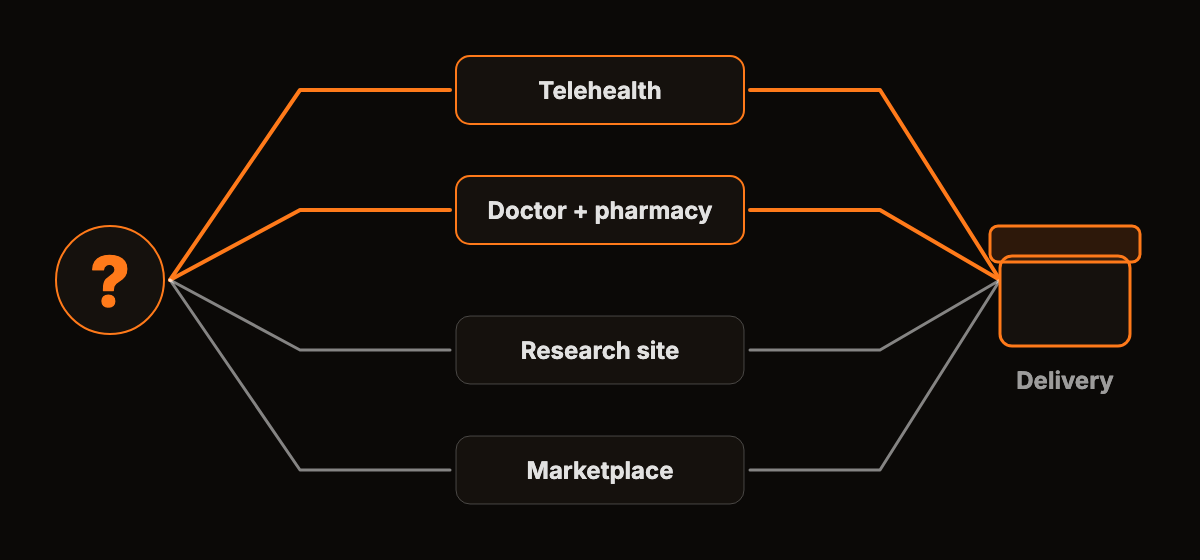
Four ways to buy peptides online, compared
People who search for the best place to buy peptides online in the USA usually find four kinds of seller. They differ in who handles the product, whether a clinician is involved, and what FDA has said. The table puts them side by side. Each cell comes from an FDA page or letter, named in the last column.
| Source type | Who dispenses | Prescription involved | FDA status of the product | What you can verify | Source |
|---|---|---|---|---|---|
| A licensed prescriber's telehealth service | A partner pharmacy that fills the prescription | Yes: a licensed clinician reviews your intake and decides | Brand drugs are FDA-approved for their labeled uses; compounded versions are not FDA-approved | The pharmacy's license, through FDA's BeSafeRx location tool | FDA consumer update on buying medicines online (page current as of 2025-01-02); FDA compounding Q&A (page current as of 2025-09-16) |
| Your own doctor plus a licensed pharmacy | The pharmacy your doctor sends the prescription to | Yes: your doctor's own judgment | Same split: an approved brand drug, or a compounded one that FDA has not approved | The pharmacy's license; the label on the dispensed product | FDA GLP-1 page (page current as of 2026-10-01) |
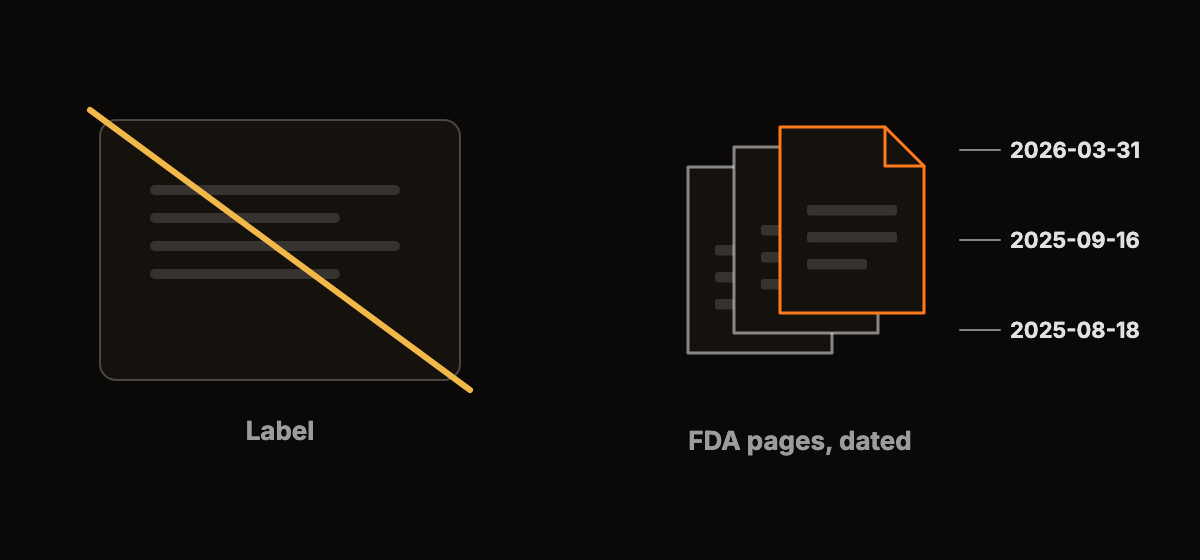
| "Research use only" websites | The website operator, with no pharmacist step | No | FDA's letters call such products unapproved new drugs | Almost nothing independent: you see only the seller's own label and page | FDA warning letter dated 2026-03-31 |
| Marketplaces and social sellers | An individual or reseller, sometimes shipping from abroad | No | Unknown; FDA calls such products "of unknown quality" | Almost nothing: the seller's identity may be hidden | FDA GLP-1 page (page current as of 2026-10-01); FDA personal importation page (page current as of 2025-08-18) |
As of 2026-10-07. Our own reading of the pages named in the last column; this is not legal advice.
The first two rows are the same route with a different front door. In both, a person who is licensed to prescribe reads your history, decides, and sends the order to a pharmacy that a state board has licensed. The last two rows skip those steps. That is the whole difference, and it is why the rest of this guide spends its time on the first two rows. For the longer version, read where peptides come from.
One more point about "peptides" as a word. It covers an enormous range of products, from semaglutide and tirzepatide, which have FDA-approved brand versions, to substances such as BPC-157, which FDA has not approved in any product. A seller who lumps all of them into one category is telling you something about how careful the seller is.
What "best" means on this site
We use the word narrowly. We do not rank sellers by price, speed or reviews. We ask five yes-or-no questions that a reader can check without special tools. FDA publishes four "safe signs" for online pharmacies: a doctor's prescription is always required, a US physical address and telephone number are given, a licensed pharmacist is on staff, and the pharmacy is licensed with a state board of pharmacy. Our criteria 1 and 2 follow those signs. Criteria 3 to 5 are our own selection from other FDA pages, not an FDA checklist, and we say so on how to choose a peptide company.
The scorecard applies the five criteria to the one service we feature, using only what Whoosh Wellness says on its own pages, read on 2026-10-07. The words in the third column are labels for what we could find, not a grade.
| Criterion | Why it matters | Whoosh as stated by Whoosh (read 2026-10-07) | How you can check it yourself |
|---|---|---|---|
| 1. A licensed prescriber reviews you | FDA's safe signs for online pharmacies start with a required doctor's prescription | STATED Whoosh says a licensed physician reviews each intake and decides whether to prescribe | Ask for the prescriber's name and state license before you pay, in writing |
| 2. A state-licensed US pharmacy dispenses it | FDA says the pharmacy should have a licensed pharmacist and a state board license | STATED Whoosh names an Ohio partner pharmacy in its FAQ. CAN'T BE CHECKED BY US: whether that license is current | Search the pharmacy in FDA's BeSafeRx location tool; FDA advises against any pharmacy it does not list |
| 3. The product's FDA status is stated plainly | FDA says compounded drugs are not FDA-approved and that it does not verify their quality | STATED on its home page, product pages and terms, which say its products come from FDA-registered facilities but are not FDA-approved. Its peptide-therapy page, as read, shows no such line | Ask whether this is a brand drug with FDA approval or a drug made by a compounding pharmacy. Look for the answer on the page you are buying from |
| 4. No pressure pricing | FDA lists deep discounts or prices that seem too good to be true as a warning sign | MIXED Its home page shows a first-order discount pop-up. We found no countdowns or scarcity wording. Its pages show different prices for the same products, so we print none | Compare the price on the product page, the cart and the written plan; walk away from a deal that expires or needs a code |
| 5. No "research use only" label on a product meant for people | FDA's warning letters say such labels do not change intended use | STATED Whoosh calls research chemicals "Not approved for human therapeutic use" on its own page and sells prescription products | Read the label and the product page: a product meant for people comes from a pharmacy, with a prescription label |
As of 2026-10-07. Whoosh's statements are its own and we have not tested its products or pharmacy.
On criterion 4, we noticed a mismatch worth knowing about: Whoosh publishes no price that we could print with confidence, because its own pages disagree with each other. That is a fact about the pages we read, and a reader who plans to buy should ask for a written price.
This page is an affiliate recommendation. We earn a commission if you start an intake through our link, and the scorecard above is the full extent of our checking. On four of the five criteria, Whoosh's own pages state what we looked for, and the fourth is mixed. That is a narrower claim than "this service is good", and it is the only one we make.
Why "research use only" is not a shortcut
The most common advice on forums is to buy a vial labeled for research, since it is cheaper and needs no prescription. FDA has addressed that advice directly, in letters we can cite by date.
In an FDA warning letter dated 2026-03-31 (page current as of 2026-04-07), FDA writes that, despite labels reading "Research Use Only" and "not intended for human consumption, medical use, or veterinary use," evidence from the seller's website establishes the products are "intended to be drugs for human use." FDA calls them unapproved new drugs. The legal test it applies is in the federal regulation on intended use, 21 CFR 201.128, which says intent can be shown by "labeling claims, advertising matter, or oral or written statements."
A later batch of letters, such as the one dated 2026-08-24, applies the same reasoning. FDA points to the diluent and syringes sold alongside the vials and to passages that summarize laboratory studies as evidence that the seller intends the products for people. Our page on research peptides explained walks through how to read such a letter.
FDA's GLP-1 page (current as of 2026-10-01) says the agency has warned firms that sold semaglutide, tirzepatide, retatrutide, survodutide or mazdutide products "falsely labeled" for research purposes or not for human consumption, and that the products were sold directly to consumers for human use with dosing instructions. The same page says FDA urges consumers not to purchase these products, which are of unknown quality, and that illegally marketed versions "may be counterfeit."
None of this is a statement about any one reader's legal exposure. The letters are addressed to sellers. What they establish for a buyer is practical: the product has no FDA approval, no pharmacist reviewed the order, and no one checked the contents on your behalf. We do not name the firms that received letters, and we do not link to any seller of unapproved products.
What Whoosh offers, and what it does not
Whoosh Wellness is the one service we feature, for one reason: it describes a prescription route that fits most of our five criteria, as its own pages state them. Here is what it says about itself, read on 2026-10-07. It is a plain list, with no ranking.
As stated by Whoosh (read 2026-10-07), it offers compounded sermorelin, semaglutide and tirzepatide, plus NAD+, glutathione and a topical GHK-Cu product; it does not offer BPC-157, CJC-1295, ipamorelin, tesamorelin or retatrutide.
- How it works, as Whoosh describes it. You answer an online questionnaire about goals and medical history. A licensed physician reviews it. If the physician judges a prescription appropriate, a licensed US compounding pharmacy prepares the medication and ships it, with monthly check-ins.
- No promise of approval. Whoosh's own terms say completing the intake "does not guarantee" a prescription.
- Who can use it. Adults in states where its services are available. Its FAQ says its partner pharmacy is licensed in 45 states and not licensed in California, Nevada, New Jersey, Alabama and Arkansas.
- What it does not list. BPC-157, CJC-1295, ipamorelin, tesamorelin and retatrutide do not appear among the products Whoosh shows, and it sells no research-labeled vials.
- Where its pages disagree. Its FAQ says its pharmacy cannot dispense sterile compounds, while its product pages list injections. We cannot resolve that, so ask in writing which pharmacy would fill which product.
- Prices. Not printed here, because Whoosh's own pages show different amounts for the same products.
Compounded medications are not FDA-approved. FDA's compounding Q&A says it does not verify their safety, effectiveness or quality.
A licensed physician decides whether a prescription is appropriate, so there is no promise of approval.
If you would rather read first, the Whoosh Wellness review goes through the same pages in more detail, including the places where they conflict.
Buy by peptide
Each guide below states the FDA status of one peptide and what route, if any, exists. They are written the same way: dated sources first, then what to ask.
- Sermorelin: FDA approved it as Geref in 1990 and 1997, then withdrew approval effective 2009-06-18; FDA's 2013 notice says this was not for safety or effectiveness reasons. Whoosh offers a compounded version.
- Tirzepatide: approved brand drugs exist, and compounded versions are not FDA-approved. Whoosh offers a compounded version.
- Semaglutide: approved brand drugs exist, and FDA warns about counterfeit and falsely labeled products. Whoosh offers a compounded version.
- BPC-157: FDA has approved no BPC-157 product, and its staff briefing of 2026-05-11 says the criteria weigh against listing it for compounding. Whoosh does not offer it.
- CJC-1295 and ipamorelin: no FDA-approved product exists for either, and FDA's safety page (current as of 2026-04-22) prints concerns for both. Whoosh does not offer either.
Read next
- Where peptides come from: the four source types, with who sells, what the law says, what you can verify and red flags for each.
- How to choose a peptide company: the five criteria, one at a time, with how to check each.
- Is it legal to buy peptides online?: what FDA and federal law say, dated.
- How to spot fake peptides: red flags in listings and certificates of analysis.
- Peptide prescription online: how an online prescription works, step by step.
Update history
- 2026-10-07: First publication. Every FDA, DailyMed, Federal Register and Whoosh statement on this page was re-read on that date; the date next to each source is the date the page itself shows.
FAQ
Where is the best place to buy peptides online in the USA?
There is no single seller we can name as the answer. The lawful route is a prescription from a licensed clinician filled by a state-licensed pharmacy, and the five criteria above let you test any seller against it. Whoosh's own pages address four of them plainly; the fourth, pricing, is mixed.
Is it legal to buy peptides online?
It depends on the product and the route. Prescription drugs filled by a licensed pharmacy are the lawful route. FDA's letters call unapproved products sold online unapproved drugs, and its personal importation page calls bringing drugs into the country for personal use illegal in most circumstances. This is not legal advice.
Are peptides sold with a research label legal for personal use?
FDA's 2026-03-31 warning letter says such a label does not change a product's intended use when the seller's own site shows the products are meant for people. The letters are addressed to sellers, but the products remain unapproved and unchecked.
Do compounded peptides have FDA approval?
No. FDA's compounding Q&A says compounded drugs are not FDA-approved and that FDA does not verify their safety, effectiveness or quality. Compounding by a state-licensed pharmacy is a lawful category, and a prescription is part of it.
Does Whoosh Wellness sell BPC-157?
Not as far as we can tell. BPC-157 does not appear among the products Whoosh shows on its product pages, pricing page or menus, as read on 2026-10-07. See the BPC-157 guide for FDA's position.
How do I check that a pharmacy is licensed?
FDA's BeSafeRx location tool searches the pharmacy records that state boards keep. A pharmacy missing from those records is, in FDA's words, one to avoid.
Do you get paid if I click the Whoosh button?
We may earn a commission if you start an intake through our link, at no extra cost to you. The scorecard uses the same five criteria for every seller, and we publish what Whoosh's pages say even where they conflict.
Sources
- FDA: How to buy medicines safely from an online pharmacy page current as of 2025-01-02, read 2026-10-07
- FDA: Considering an online pharmacy (BeSafeRx) page current as of 2020-09-21, read 2026-10-07
- FDA: Compounding and the FDA, questions and answers page current as of 2025-09-16, read 2026-10-07
- FDA: Concerns with unapproved GLP-1 drugs used for weight loss page current as of 2026-10-01, read 2026-10-07
- FDA warning letter dated 2026-03-31 page current as of 2026-04-07, read 2026-10-07
- FDA warning letter dated 2026-08-24 read 2026-10-07
- FDA: Personal importation page current as of 2025-08-18, read 2026-10-07
- 21 CFR 201.128: Meaning of intended uses read 2026-10-07
- FDA: Certain bulk drug substances for use in compounding that may present significant safety risks page current as of 2026-04-22, read 2026-10-07
- FDA briefing document on BPC-157, dated 2026-05-11 read 2026-10-07
- Federal Register notice, 2013-03-04 (78 FR 14095) read 2026-10-07
- Whoosh Wellness home, FAQ, how-it-works, pricing, terms and product pages, read 2026-10-07
Not medical advice. See the medical disclaimer.