Quick answer: For a prescription peptide drug, FDA's guidance is to get a prescription from your doctor and fill it at a state-licensed pharmacy. That points to a licensed pharmacy, including a compounding pharmacy filling an order for you by name, and not to a store counter or a gym. Compounded medications are not FDA-approved. FDA also says many peptides have no approval at all.
"Peptides near me" is a search that mixes very different places: a supplement shop, a gym with a back room, a med spa, a clinic, a community pharmacy, a compounding pharmacy. They operate under different licenses, and what each may lawfully hand you is not the same. This page sorts them using FDA's published statements. Some links on this site are affiliate links; none appear on this page, and we name no businesses.
We are not lawyers and we do not say that any particular business is or is not acting lawfully. We report what FDA says about prescriptions, pharmacies and compounding, then give questions you can ask. State rules vary, and we did not review all fifty states.
The short rule FDA gives
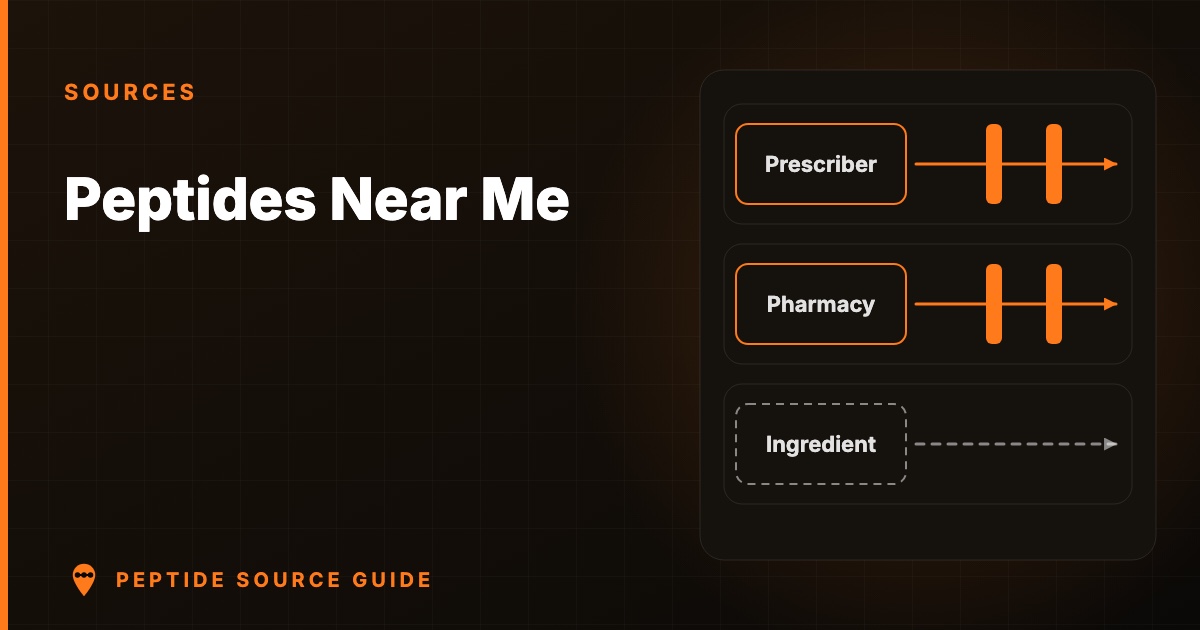
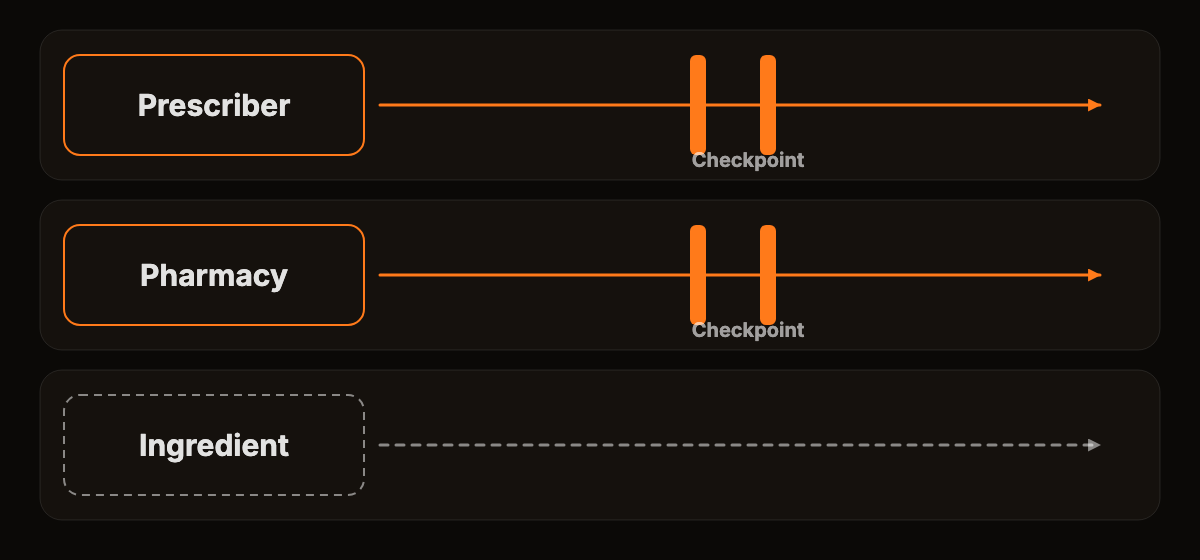
FDA's page on unapproved GLP-1 drugs (current as of 2026-10-01) says patients should "obtain a prescription from their doctor and fill the prescription at a state-licensed pharmacy." FDA's consumer update on buying medicine online names the same pair of tests: a prescription requirement, and a pharmacy licensed by a state board with a pharmacist on staff. Those pages are written about online sellers, but the logic carries over to a storefront: the two things to look for are a prescriber and a state-licensed pharmacy.
That gives you a way to sort places before you drive anywhere. A business that can show a prescriber's order and a pharmacy license is in the lane FDA describes. A business that sells a vial across a counter with neither is not in that lane, whatever the sign on the door says. This is our reading of FDA's guidance, not an FDA ruling about any place.
What a store or clinic may lawfully hand you
This is the unique section of the page. Each row below describes a type of place and summarizes what FDA's statements support. The right-hand column gives a question to ask.
| Place | What FDA's statements say about it | A question to ask |
|---|---|---|
| Supplement or nutrition store | In an FDA briefing, a popular peptide is described as sold in oral supplements; FDA states no legal conclusion on them. A shop is not a pharmacy and cannot fill a prescription. | "Is this product sold as a supplement or as a drug, and where is its FDA status stated on the label?" |
| Gym or fitness studio | We found no FDA statement that supports a gym dispensing an injectable drug. A gym is not a pharmacy by virtue of being a gym. | "Who is the licensed prescriber, and which licensed pharmacy filled this?" |
| Med spa or wellness clinic | FDA's ipamorelin briefing (2024-10-29) says such formulations are "increasingly being marketed by medical spas and wellness clinics." A clinic may employ or contract a prescriber, but the drug still has to come from a pharmacy or an FDA-approved supply chain. | "Is a licensed prescriber examining me, and who is the pharmacy?" |
| Your own doctor's office | A prescriber can write an order for an approved drug or, if the prescriber judges that your needs cannot be met by an approved drug, for a compounded one. | "Is there an approved drug that fits, and if not, why this compounded one?" |
| Community pharmacy | Fills prescriptions for approved brand drugs. FDA says to fill prescriptions at a state-licensed pharmacy. | "Can you fill this, and is it the approved product?" |
| Compounding pharmacy | Under section 503A, may compound for an identified patient on a valid prescription order. FDA's compounding page says compounded drugs are not FDA-approved and that state boards have primary day-to-day oversight of such pharmacies. | "Which state licensed you, and is my ingredient eligible?" |
As of 2026-10-07. This is a summary of FDA statements, not a ruling on any specific business.
Why the prescription is the dividing line
Section 503A of the Federal Food, Drug, and Cosmetic Act, in its statute text, makes compounding eligible for the exemption when a drug is compounded "for an identified individual patient based on the receipt of a valid prescription order." The statute allows limited compounding in advance of a prescription only on the basis of a history of valid prescription orders within an established relationship. The compounding pharmacy's lane begins with a patient and a prescriber, and not with a shelf.
FDA's compounding page also limits their use to patients an approved drug cannot serve. For approved products, such as Zepbound or Wegovy, the manufacturers' own pages describe a prescription medicine, and Lilly's Zepbound page says it "requires a valid prescription from a licensed healthcare provider."
The ingredient matters as much as the place
A licensed pharmacy is necessary, but it is not sufficient. Under FDA's 503A bulk-substance page (current as of 2026-05-14), a compounder's ingredient must have a monograph, be part of an approved drug, or be on FDA's list. FDA's page on substances that may present significant safety risks (current as of 2026-04-22) lists ipamorelin acetate in an active table for 503B and prints safety concerns for several other peptides that were withdrawn by their nominators. Our guide to compounded peptides walks through this in plain words.
For GLP-1 drugs, FDA's page says retatrutide and cagrilintide "cannot be used in compounding under federal law." It also says that a compounder must not compound "regularly or in inordinate amounts" drugs that are "essentially copies" of a commercially available product. So a pharmacy can be licensed and still be asked to supply something FDA says it cannot lawfully compound.
What a state board has said about clinics
State boards also speak. An Ohio State Board of Pharmacy document, updated 2025-12-08, says the board has summarily suspended more than 30 clinics and medical spas since the start of 2025, and that any drug labeled "for research purposes only" is unlawful for prescriber clinics and med spas to possess. That is one state's statement and we cannot speak for others. It illustrates that state regulators inspect these businesses, and that a clinic's license, not its marketing, is what a board looks at.
The same document names BPC-157 among substances that cannot be compounded. FDA's own page has since placed BPC-157 under "nominated but withdrawn," and we do not know whether Ohio has updated its text, so we leave that sentence out of our summary and tell you to check your state board's current list.
Reading the room: signs from FDA's lists
FDA's red flags for GLP-1 telehealth sellers apply to storefronts too. They include no screening by a licensed doctor before the medicine is provided, no licensed doctor available to answer questions afterward, a claim that a compounded drug "is the same as" an approved drug, deep discounts, and labels with spelling errors or a wrong pharmacy address. Our guide to spotting fake peptides lists each with its source.
Add one more from FDA's research-label letters. If a business hands you a vial labeled "research use only" or "not for human consumption" together with advice about using it on yourself, FDA's letters dated 2026-03-31 say such labels do not change a product's intended use when the seller's own evidence shows human use. That is a warning about the product and the seller, and not a verdict on you. See research peptides explained.
Questions to ask before you go
Write the answers down or ask for them by email. A business that follows the rules should be able to answer without discomfort.
- Who is the prescriber, and will they examine me? FDA lists no screening by a licensed doctor as a red flag.
- Which pharmacy fills the order, and in which state is it licensed? FDA says to check a pharmacy's license in the state board database through BeSafeRx.
- Is the product an approved brand drug or a compounded one? Compounded medications are not FDA-approved, and the answer should be stated plainly.
- What is the FDA status of the ingredient? A seller who cannot say is a flag. Our five-point check uses this as criterion 3.
- Is there pressure to decide today? FDA names deep discounts that seem too good to be true as a warning. Countdowns and coupon urgency are our addition under criterion 4.
- What is on the label? FDA warns about spelling errors, wrong pharmacy addresses and missing instructions.
- Whom do I call if something goes wrong? FDA lists no licensed doctor available afterward as a red flag.
- What will this cost, in writing, including renewals? Our cost guide explains what is inside a price.
The same five criteria apply in person and online. In order: (1) a licensed prescriber reviews you; (2) a state-licensed US pharmacy dispenses it; (3) FDA status is plain; (4) no pressure pricing; (5) no research or "not for human consumption" label on a product meant for people. Only the first two follow FDA's published safe signs; the rest are our selection.
If there is no place near you
Some peptides have no lawful route in a storefront because they have no approval and no eligible compounding status. For those, the honest answer to "where can I buy it near me" may be "nowhere that FDA's statements support." Where a prescription route exists, it may be reached through your own doctor or through an online prescriber and licensed pharmacy; our prescription walkthrough describes the steps.

Sources
- FDA: concerns with unapproved GLP-1 drugs used for weight loss page current as of 2026-10-01, read 2026-10-07
- FDA: how to buy medicines safely from an online pharmacy page current as of 2025-01-02, read 2026-10-07
- FDA: compounding and the FDA, questions and answers page current as of 2025-09-16, read 2026-10-07
- Cornell LII: 21 USC 353a, pharmacy compounding read 2026-10-07
- FDA: bulk drug substances used in compounding under section 503A page current as of 2026-05-14, read 2026-10-07
- FDA: bulk drug substances that may present significant safety risks page current as of 2026-04-22, read 2026-10-07
- FDA: briefing document on ipamorelin, Pharmacy Compounding Advisory Committee, 2024-10-29 read 2026-10-07
- FDA: briefing document on BPC-157, Pharmacy Compounding Advisory Committee, 2026-07-23 and 2026-07-24 read 2026-10-07
- FDA warning letter dated 2026-03-31 page current as of 2026-04-07, read 2026-10-07
- LillyDirect: Zepbound read 2026-10-07
- Ohio State Board of Pharmacy, "Ten Common Prescriber Clinic and Medical Spa Violations," updated 2025-12-08, a state document on pharmacy.ohio.gov, read 2026-10-07
FAQ
Can I buy peptides at a store near me?
For a prescription drug, FDA's guidance is a prescription filled at a state-licensed pharmacy. A store that is not a pharmacy cannot fill a prescription. Some products are sold in stores as supplements, and FDA has not stated a legal conclusion about them in the document we read.
Can a gym or med spa sell peptides?
We found no FDA statement that supports a gym dispensing an injectable drug. A med spa may work with a prescriber, but the product should still come from a licensed pharmacy or an approved supply chain, so ask who the prescriber and the pharmacy are.
Is a compounding pharmacy the same as a regular pharmacy?
Both are state-licensed pharmacies. A compounding pharmacy prepares drugs for named patients under section 503A, and FDA says compounded drugs are not FDA-approved. A community pharmacy mainly fills approved products.
How do I check a pharmacy's license?
FDA's BeSafeRx material says to look the pharmacy up in the state board database through its location tool, and that if the pharmacy is not listed, do not use it.
Do I need a prescription?
For the prescription drugs FDA discusses, yes. FDA's guidance names a doctor's prescription and a state-licensed pharmacy as the two requirements.
What if a business hands me a "research" vial?
FDA's letters say a research label does not change a product's intended use when the seller's evidence shows human use. Count it as a flag, ask the questions above, and speak with a licensed clinician.
Not medical advice. See the medical disclaimer.