Quick answer: Side effects are documented in detail only for peptide drugs FDA has approved, because each has a label. The labels for semaglutide and tirzepatide carry a boxed warning about thyroid tumors seen in rodents. Compounded and "research" peptides have no label of their own. Compounded medications are not FDA-approved, and FDA says it does not review them for safety before they are marketed.
This page answers one question: what do official documents say can go wrong? It reports what FDA labels and FDA pages state, with their dates, and it does not rank products or predict how any individual will respond. This site earns affiliate commissions from one partner, which has no say in what this page reports. Whether any medicine is appropriate for you is a decision for a licensed prescriber.
Why "side effects" means different things for different peptides
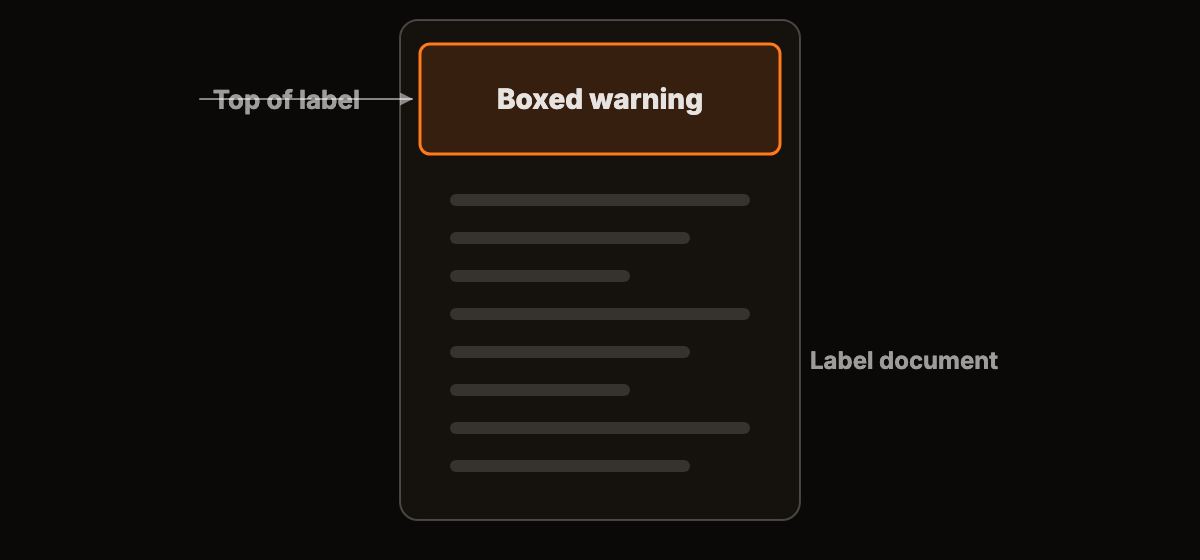
A side effect list is a regulatory document before it is a medical one. For an approved drug, the maker runs studies, FDA reviews them, and the findings become the label: the boxed warning, the warnings and precautions, and a table of adverse reactions. Anyone can read the current label on DailyMed.
Most of what people call "peptide therapy" has no such document. The approved peptide drugs are a short list (see FDA-approved peptides). Everything else, including most of the products sold online, sits outside that system. So when a seller says a peptide has "few side effects," ask which document says so. A label is a document. A product page is marketing.
What the labels of approved peptide drugs list
Each item below is attributed to a label and its date, as read on DailyMed on 2026-10-07. The label is the source, not us.
Semaglutide and tirzepatide. The current labels for Wegovy (label dated 2026-06-18), Ozempic (2026-06-01), Zepbound (2026-08-28) and Mounjaro (2026-08-27) each open with a boxed warning titled WARNING: RISK OF THYROID C-CELL TUMORS. The semaglutide labels say the drug causes thyroid C-cell tumors in rodents, and the tirzepatide labels say the same of rats. Each label says it is "unknown whether" the drug causes these tumors, including medullary thyroid carcinoma, in humans. Each lists a personal or family history of that cancer, or of Multiple Endocrine Neoplasia syndrome type 2, as a contraindication. The labels say routine calcitonin monitoring or thyroid ultrasound is of uncertain value for early detection.
The Saxenda label (2026-02-25) and the Victoza label (2025-10-14), both for liraglutide, carry the same boxed-warning title.
The common reactions the labels print. The labels list "most common adverse reactions" at stated thresholds. The Wegovy label (2026-06-18) lists, at 5 percent or more, nausea, diarrhea, vomiting, constipation, abdominal pain, headache, fatigue, dyspepsia, dizziness and hair loss, among others. The Ozempic label (2026-06-01) lists nausea, vomiting, diarrhea, abdominal pain and constipation. The Zepbound label (2026-08-28) lists nausea, diarrhea, vomiting, constipation, abdominal pain, dyspepsia, injection site reactions, fatigue, hypersensitivity reactions, hair loss and reflux, among others. The Mounjaro label (2026-08-27) lists nausea, diarrhea, decreased appetite, vomiting, constipation, dyspepsia and abdominal pain.
Tesamorelin. The Egrifta WR label (2026-07-29) is approved for reduction of excess abdominal fat in HIV-infected adult patients with lipodystrophy and says it is not indicated for weight loss management. We found no boxed warning in it. Its warnings and precautions headings include increased risk of neoplasms, elevated IGF-1 levels, fluid retention, glucose intolerance or diabetes, hypersensitivity reactions, injection site reactions, and increased mortality in patients with acute critical illness. It lists joint pain, injection site redness and itching, pain in an arm or leg, swelling, and muscle pain as the most commonly reported reactions. The label says long-term cardiovascular safety "has not been established".
Other approved peptides. The Forteo label (2026-08-03) lists joint pain, pain and nausea among its most common reactions. The Vyleesi label (2025-11-13) lists nausea, flushing, injection site reactions, headache and vomiting. The Imcivree label (2026-04-01) lists skin darkening, injection site reactions, nausea, headache, diarrhea and abdominal pain, among others. These are shorter lists for different products. They do not carry over to any other peptide.
Sermorelin. The Geref product was approved in 1990 and 1997, and its approval was withdrawn effective 2009-06-18. We did not find a current FDA or DailyMed label for it, so we do not list its side effects. The only copy of the older label text we found was a non-FDA reproduction, which we have not relied on.
As of 2026-10-07. A label lists what was observed in the studies behind it and in reports after approval. A reaction missing from a label is not evidence that it cannot happen, and a reaction on the label does not mean it will.
Why an unapproved peptide has no label of its own
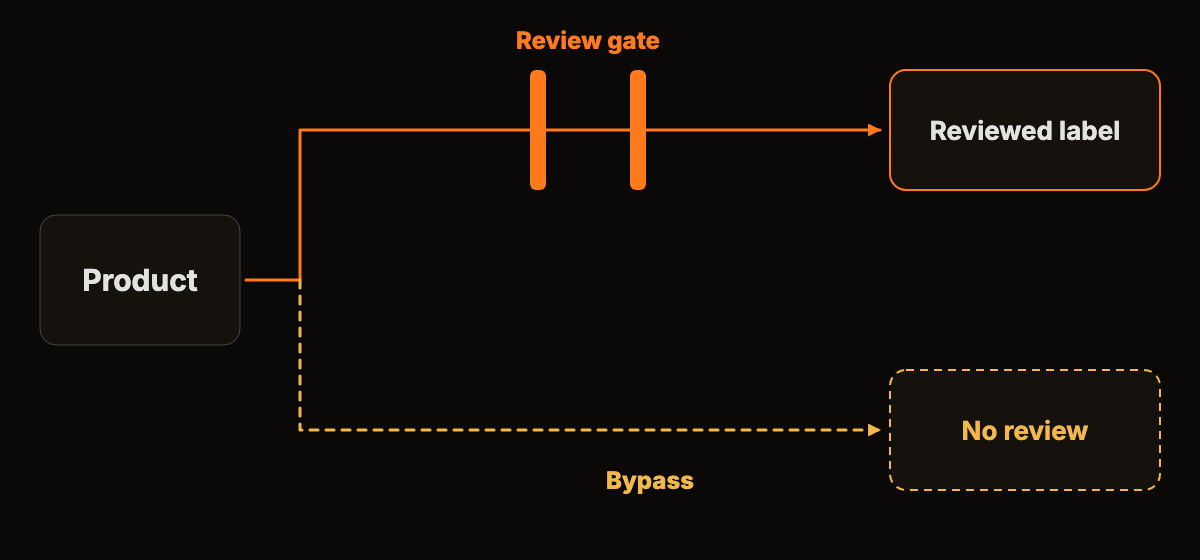
A label is the end product of an FDA review. Without a review, there is no label, and the table of known reactions never gets written. That is the situation for compounded versions of these drugs and for products sold under "research" wording.
FDA's statements about compounded drugs. In FDA's concerns page on unapproved GLP-1 drugs (page current as of 2026-10-01), the agency says compounded drugs are not FDA-approved and that it does not review them for safety, effectiveness or quality before marketing. FDA's compounding Q&A page (current as of 2025-09-16) says poor compounding practices can result in serious quality problems, such as contamination or a drug with too much or too little active ingredient. Compounded medications are not FDA-approved, which means no label of the kind described above exists for them. A prescriber and pharmacy decide what a patient is given and what to watch for.
FDA's concerns about specific peptides. FDA's page on bulk substances that may present significant safety risks (current as of 2026-04-22) prints a safety paragraph for several popular peptides. These are FDA's statements, not ours:
- For ipamorelin, FDA says a study published in the literature identified serious adverse events, including death, when it was given intravenously for improving gastric motility. FDA also cites a risk of immunogenicity for certain routes, because of the potential for aggregation or peptide-related impurities. FDA lists ipamorelin acetate in its active Category 2 table for outsourcing facilities, added 2023-09-29.
- For CJC-1295, FDA says it has identified serious adverse events associated with it, including increased heart rate and a systemic vasodilatory reaction, and that available clinical data are limited.
- For BPC-157, FDA says the agency "lacks sufficient information to know whether the drug would cause harm" in humans, and flags immunogenicity and peptide-related impurities for certain routes.
- For TB-500, FDA says it has not identified any human exposure data.
"Immunogenicity" means the body may form an immune response to the product. FDA's page says the cause can be aggregation, where molecules clump, or impurities left from making the peptide. Both BPC-157 and CJC-1295 appear on that page in a table of substances that were nominated for compounding and later withdrawn by the nominators; the page says these were previously in Category 2. They remain subject to the safety text FDA prints. For their regulatory status in detail, see where to buy BPC-157 and where to buy CJC-1295 and ipamorelin.
FDA's adverse-event counts for compounded GLP-1 drugs. FDA's GLP-1 page (current as of 2026-10-01) says that as of 2026-05-31 it had received 990 reports of adverse events associated with compounded semaglutide and more than 730 for compounded tirzepatide. FDA adds three cautions. First, pharmacies that are not outsourcing facilities are not required to report, so FDA says it is likely events are underreported. Second, it is not always possible to determine whether the drug caused an event. Third, FDA says many reported events appear consistent with those of the approved versions. A count of reports is not an incidence rate, and it cannot show how common a problem is.
FDA's dosing-error alert. FDA's alert on compounded semaglutide (page dated 2024-07-26) describes adverse events, some requiring hospitalization, that were possibly caused by dosing errors. It says patients drew up several times more than intended from a multi-dose vial, that some prescribers miscalculated, and that confusion among milliliters, milligrams and "units" played a part. The events FDA lists include nausea, vomiting, abdominal pain, fainting, headache, dehydration, acute pancreatitis and gallstones. FDA also describes reports of patients prescribed amounts beyond the approved label. This site gives no dose numbers and no how-to for vials or syringes; the point is that the unit of measure itself became a hazard when a product had no standard packaging.
Products with no prescriber involved. FDA's warning letters to sellers of "research" products say they are unapproved new drugs, and say the "not for human consumption" labels do not change what the product is intended for. See research peptides explained. With no prescriber, no pharmacy and no label, nobody is positioned to tell you what to watch for or to report a problem.
Where problems are reported
FDA's consumer update on buying medicine online (current as of 2025-01-02) says adverse effects can be reported to FDA's MedWatch program, and that unsafe online pharmacies can be reported to FDA as well. The same page lists the signs of a safe online pharmacy: a prescription is always required, a physical US address and telephone number are given, a licensed pharmacist is on staff, and a state board of pharmacy licenses the business. Reporting also helps FDA's counts, which it says are incomplete.
What to ask a prescriber
These are questions, not advice. A licensed prescriber can answer them for your situation.
- What is this product's FDA status in plain words, and if it was made by a compounding pharmacy, which state licenses that pharmacy?
- Is there a label or an FDA page I can read for this product? If not, what is the source of the safety information you are relying on?
- What should I stop and report, and to whom, if something goes wrong?
- Who answers questions after the product arrives? FDA lists "no licensed doctor available" after receipt as a telehealth red flag.
- Do my history, my other medicines or a family history change the risks the label lists?
For the five checks we use on any seller, see how to choose a peptide company.
What this page cannot tell you
It cannot say how likely any effect is for you, and it does not tell you what to use or avoid. It also cannot cover products no agency has documented. For peptides without a label, the honest summary of the official record is the one FDA gives for BPC-157: the agency lacks the information to know. Absence of reports is not evidence of safety.
Sources
- FDA: Certain bulk drug substances for use in compounding that may present significant safety risks page current as of 2026-04-22, read 2026-10-07
- FDA: FDA's concerns with unapproved GLP-1 drugs used for weight loss page current as of 2026-10-01, read 2026-10-07
- FDA: Alert on dosing errors with compounded semaglutide page dated 2024-07-26, read 2026-10-07
- FDA: Compounding and FDA, questions and answers page current as of 2025-09-16, read 2026-10-07
- FDA: How to buy medicines safely from an online pharmacy page current as of 2025-01-02, read 2026-10-07
- DailyMed: Wegovy label label effective 2026-06-18, read 2026-10-07
- DailyMed: Ozempic label label effective 2026-06-01, read 2026-10-07
- DailyMed: Zepbound label label effective 2026-08-28, read 2026-10-07
- DailyMed: Mounjaro label label effective 2026-08-27, read 2026-10-07
- DailyMed: Egrifta WR label label effective 2026-07-29, read 2026-10-07
FAQ
Do peptides have side effects?
Approved peptide drugs do, and their labels list them with dates. For products without a label, no agency has published a comparable list, so the accurate answer is that the effects are not documented in the same way.
Where do I find the side effects of Wegovy or Zepbound?
On the current label at DailyMed, which is linked in the sources above. The label's boxed warning, its warnings and precautions, and its adverse reactions table are the official record.
Why does a compounded product have no label?
A drug label comes out of FDA review, and FDA says it does no such review of compounded drugs before they are sold, so none exists. Compounded medications are not FDA-approved.
What does FDA say about the number of reports for compounded GLP-1 drugs?
FDA reported 990 reports for compounded semaglutide and more than 730 for compounded tirzepatide as of 2026-05-31. It says events are likely underreported and that causation is not always possible to determine.
What is immunogenicity in FDA's safety text?
It is the risk that the body mounts an immune response to a product. FDA's page ties it to aggregation and peptide-related impurities for certain routes of administration.
Where can I report a problem?
FDA's consumer update says adverse effects can be reported to MedWatch. Unsafe online pharmacies can also be reported to FDA, and your prescriber or pharmacist can help you file.
Not medical advice. See the medical disclaimer.