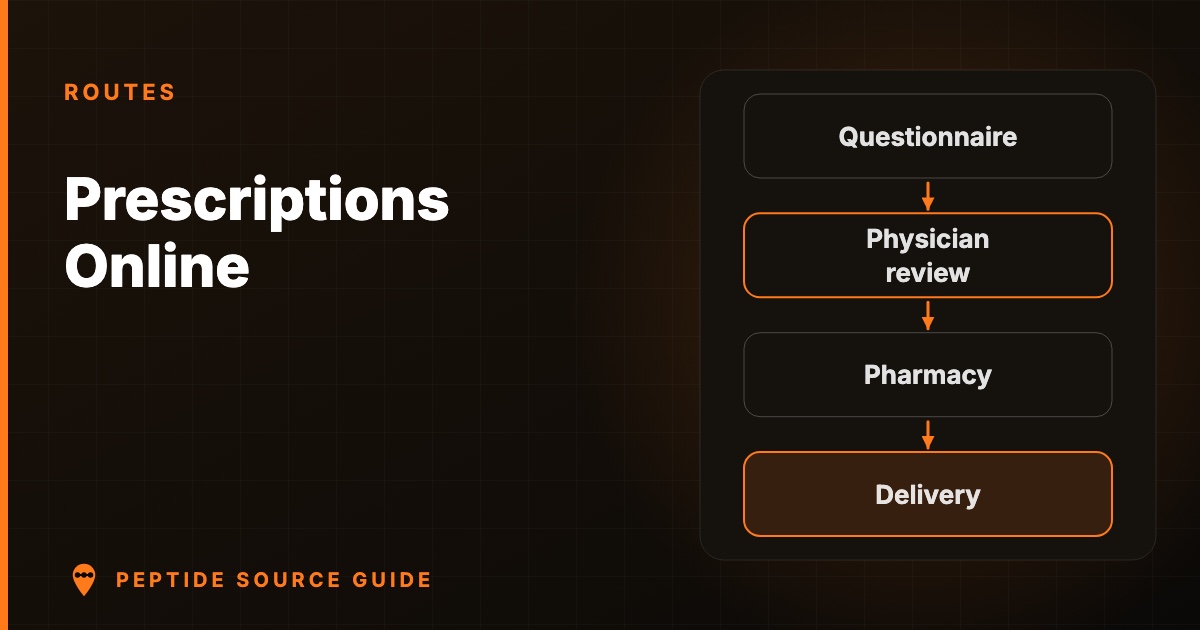
Quick answer: A lawful online prescription follows the pattern FDA describes: a licensed prescriber reviews you, and a state-licensed pharmacy fills the order. Whoosh Wellness describes its own path as a questionnaire, a licensed provider's review and a licensed pharmacy (as stated by Whoosh, read 2026-10-07). Compounded medications are not FDA-approved. Many popular peptides have no FDA-approved product at all, so a prescription route does not exist for every product people ask about.
Some links on this page are affiliate links, which means we may earn a commission if you use them. That does not change what the sources say, and this page reports where Whoosh's own pages disagree with each other. If you are comparing routes first, where peptides come from sorts the four source types, and how to choose a peptide company gives the five checks we use throughout this site.
What any lawful prescription route looks like, per FDA
FDA does not publish a peptide-specific rule for buying online. It does publish general guidance on buying medicine online, and that guidance is the yardstick we apply to every service on this site, including Whoosh.
FDA's BeSafeRx consumer update (page current as of 2025-01-02, read 2026-10-07) lists four signs of a safe online pharmacy:
- It always requires a doctor's prescription.
- It gives a physical address and telephone number in the United States.
- It has a licensed pharmacist on staff.
- It is licensed with a state board of pharmacy.
FDA tells readers to check the pharmacy's license in the state board database through the BeSafeRx location tool. Its advice for a pharmacy that is not listed is short: "don't use that pharmacy." The same update names warning signs, including no prescription required, no US license, and "deep discounts or prices that seem too good to be true."
On its page about unapproved GLP-1 drugs (current as of 2026-10-01), FDA's instruction on that page is to get the prescription from your own doctor and have a state-licensed pharmacy fill it. That page also lists telehealth red flags: no screening and prescription by a licensed doctor before medicine is provided, no licensed doctor available to answer questions after it arrives, and claims that a compounded drug "is the same as" an approved one.
Two cautions follow from FDA's own pages. First, FDA says on its telehealth marketing page (current as of 2026-06-15) that it does not approve or license any facility, so a statement that a pharmacy is "FDA-approved" deserves a question. Second, FDA publishes four safe signs. The five criteria on this site add three more, drawn from other FDA pages, and are our selection rather than an FDA checklist. The scorecard version sits in the peptide source checklist.
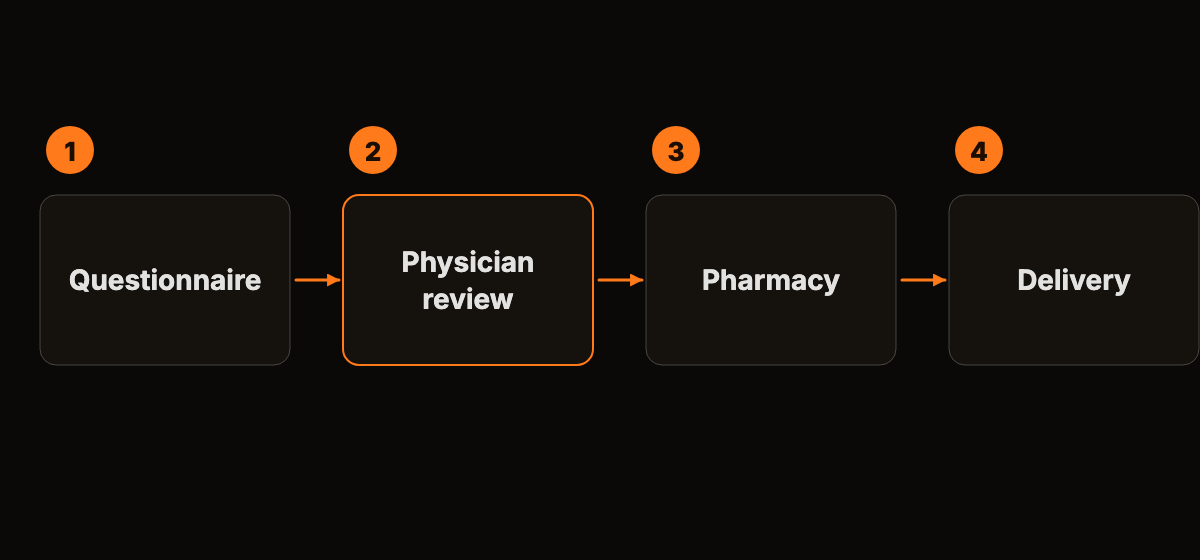
Step by step, as stated by Whoosh (read 2026-10-07)
Everything in this section is what Whoosh says on its own pages. We have not used the service, and we cannot check any of these statements ourselves. Where Whoosh's pages differ from one another, we say so.
1. A questionnaire. Whoosh's how-it-works page describes a questionnaire about goals, lifestyle and medical history, which it puts at "about 5 minutes." Its terms say that false or misleading answers may result in denial or termination of services, so the answers matter to the reviewer.
2. A licensed provider reviews it. The same page says a licensed doctor reviews each intake individually and prescribes only "If it's right for you." The terms say completing the intake "does not guarantee" a prescription and that a provider may find the service not appropriate based on your history. The terms also say Whoosh itself does not provide medical care; prescriptions are decided by licensed providers using "independent clinical judgment." The FAQ says you do not have to meet your provider, and the terms add that telehealth may be asynchronous, with "the inability to perform a physical examination."
3. Timing varies across its pages. One page says most reviews are completed within 1-2 hours. Others say most people hear back within 24 hours. A third says shipping typically arrives within 3 days. These are Whoosh's own descriptions of typical cases, they do not agree with one another, and none of them is a promise of any outcome. We print none of them as fact.
4. Billing is tied to the physician's decision. The pricing page says "You are only billed if a licensed physician approves your prescription." That is a statement about when a charge happens. It does not say that approval is likely. We print no Whoosh price because its pricing page, get-started page and product pages show different amounts for the same products.
5. A pharmacy fills it. The how-it-works page says the medication is compounded at a licensed 503A/503B US pharmacy and shipped. Whoosh's FAQ names one partner pharmacy: F&F Pharmacies Inc, doing business as Jungle Jim's Pharmacy, in Fairfield, Ohio, which it says can dispense in 45 states. The FAQ says that pharmacy is not licensed in California, Nevada, New Jersey, Alabama and Arkansas. Product pages refer only to "accredited compounding pharmacy partners," in the plural, without naming them, and Whoosh does not say which pharmacy fills which product or which is a 503A pharmacy and which is a 503B facility. Ask for the pharmacy's name and state license number in writing, then check it as FDA advises.
6. States. The terms say the service is for adults aged 18 or over "located in a state where our services are available," and that availability may vary with state law and pharmacy licensing. We found no list of the states Whoosh serves. The FAQ states a limit on the pharmacy's license; it does not say Whoosh as a whole is unavailable in those five states.
7. Check-ins and plans. The how-it-works page describes monthly check-ins. The pricing page lists monthly, 3-month and 6-month plans with automatic monthly refills, and the terms say subscriptions may renew automatically unless canceled before the next billing cycle.
8. Cancellation and refunds. The pricing page says "You can always cancel before your next renewal date." The return policy says it cannot accept returns of prescription products for reuse or resale, and that all sales are final. We did not find a money-back guarantee on any page we read, and we did not find a described refund process for a canceled renewal.
As stated by Whoosh (read 2026-10-07), it offers compounded sermorelin, semaglutide and tirzepatide, plus NAD+, glutathione and a topical GHK-Cu product; it does not offer BPC-157, CJC-1295, ipamorelin, tesamorelin or retatrutide. Compounded medications are not FDA-approved, and Whoosh's own terms say they are not reviewed or approved by FDA for safety or efficacy.
A licensed physician decides whether a prescription is appropriate, so there is no promise of approval.
As of 2026-10-07. Whoosh pages read: how-it-works, FAQs, pricing, terms and conditions, return policy.
Where the process stops being checkable
A prescription route can be described accurately and still hide things from a reader. Three limits apply here.
What the intake decides. A provider can say no. The intake form is a medical screen, not an order form, and the outcome belongs to the licensed physician. Anyone who cannot accept a "no" should not start.
Which pharmacy, and how it is licensed. FDA's advice is to check the license in the state board database. Whoosh names one pharmacy in its FAQ and refers to others in the plural elsewhere. You can check the named one; you cannot check the unnamed ones until you are told who they are.
What the product is. FDA's compounding page says compounded drugs are not FDA-approved, and FDA "does not verify the safety, effectiveness or quality" of them. A prescription changes who is responsible for the decision. It does not change the product's FDA status. For the difference between the two kinds of compounder, read compounded peptides.
What a prescription cannot do
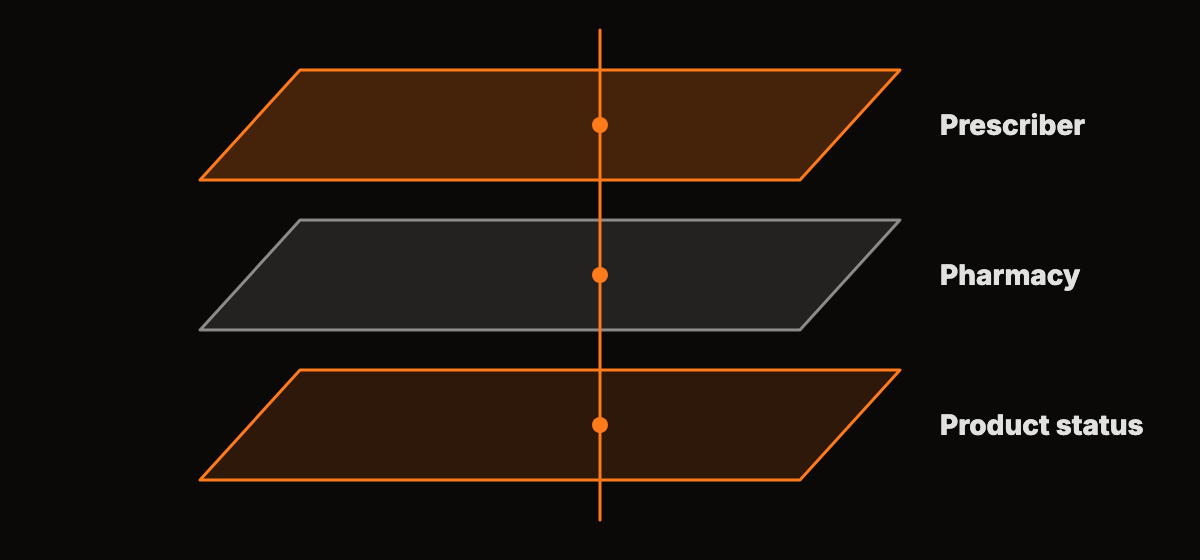
Several peptides that people search for have no FDA-approved product, and a prescriber's order cannot create one. FDA's staff briefing for BPC-157, dated 2026-05-11, says it is not a component of an FDA-approved drug. FDA says retatrutide cannot be used in compounding under federal law (page current as of 2026-10-01). The table of approved peptide drugs and the second table of peptides without approval are on FDA-approved peptides.
Whoosh says it does not offer BPC-157, CJC-1295, ipamorelin, tesamorelin or retatrutide, and its sitemap shows no product page for them. For what FDA says about BPC-157, see where to buy BPC-157. For the tirzepatide route in particular, with the approved brands set beside the compounded versions, see buy tirzepatide online.
If your prescriber is your own doctor, the same logic applies. A state-licensed pharmacy fills the order, and the FDA status of the product is stated on the label or in the pharmacy's paperwork. If a seller tells you a prescription is "optional" or "not needed," that is one of FDA's warning signs and a reason to stop.
Questions to put in writing before you start
These apply to any service, not only Whoosh. Print them or copy them into an email, and keep the answers.
- What is the name of the pharmacy, and in which state is it licensed?
- Is the product an approved brand or a compounded version, and does the paperwork say it is not FDA-approved?
- Who is the prescriber, and how can I reach a licensed clinician after the product arrives?
- What happens at each check-in, and what would make you stop the prescription?
- What is the full written price, how does renewal work, and how do I cancel?
- What is the refund or return rule if the product arrives damaged or warm?
FDA says on its GLP-1 page that it has received complaints of injectable products arriving warm or with too little refrigeration, and it recommends not using one that arrives that way. The sixth question is there for that reason. The printable peptide source checklist covers similar ground.
How to read the speed claims
Fast approval claims are the part of this process most likely to mislead a first-time reader. A fast review is not a better review. FDA's red flags for telehealth include no screening by a licensed doctor before medicine is provided, so the question to ask is what the review looked at, not how quickly it finished.
Read a page that quotes a timing figure as a marketing statement rather than a service level. Whoosh's own pages give two different figures for the same step. A provider who needs more information, or who decides the service is not appropriate, will take longer or say no, and that is the process working as FDA's guidance expects it to work.
Sources
- FDA: How to buy medicines safely from an online pharmacy page current as of 2025-01-02, read 2026-10-07
- FDA: Considering an online pharmacy page current as of 2020-09-21, read 2026-10-07
- FDA: Concerns with unapproved GLP-1 drugs used for weight loss page current as of 2026-10-01, read 2026-10-07
- FDA: Telehealth companies, what to know when promoting compounded drugs page current as of 2026-06-15, read 2026-10-07
- FDA: Compounding and FDA, questions and answers page current as of 2025-09-16, read 2026-10-07
- FDA: BPC-157 briefing document memo dated 2026-05-11, read 2026-10-07
- Whoosh Wellness: How it works read 2026-10-07
- Whoosh Wellness: FAQs read 2026-10-07
- Whoosh Wellness: Pricing read 2026-10-07
- Whoosh Wellness: Terms and conditions read 2026-10-07
- Whoosh Wellness: Return policy read 2026-10-07
FAQ
How does an online peptide prescription work?
By FDA's description, a licensed prescriber reviews you and a state-licensed pharmacy fills the order. Whoosh describes a questionnaire, a licensed provider's review and a licensed pharmacy, with monthly check-ins (as stated by Whoosh, read 2026-10-07).
Will I be approved if I complete the questionnaire?
Not necessarily. Whoosh's terms say completing the intake does not guarantee a prescription, and a licensed physician decides whether one is appropriate. Nobody can promise an outcome before that review.
Am I charged if the provider says no?
Whoosh's pricing page says you are only billed if a licensed physician approves your prescription. Read the written terms at checkout, because we could not check how billing works in practice.
Which states does Whoosh serve?
We found no list. Whoosh's FAQ says its named pharmacy is not licensed in California, Nevada, New Jersey, Alabama and Arkansas, and its terms say availability may vary with state law and pharmacy licensing. Ask in writing before you pay.
Can I get BPC-157 or CJC-1295 through this route?
Whoosh says it does not offer them, and FDA has approved no product containing either. See where to buy BPC-157 and the Whoosh Wellness review.
Is a prescription the same as FDA approval?
No. A prescription is a clinician's order. FDA approval attaches to a product. Compounded medications are not FDA-approved even when a licensed pharmacy fills a valid prescription.
What if the product arrives warm?
FDA recommends not using an injectable GLP-1 product that arrives warm or with insufficient refrigeration. Contact the prescriber and pharmacy in writing, and report problems to FDA through MedWatch.
Not medical advice. See the medical disclaimer.