Quick answer: We found no solid third-party source for what general "peptide therapy" costs. Every figure we found came from sellers and clinics. Dated figures exist only for FDA-approved brand drugs, where manufacturers state self-pay programs that change. Compounded medications are not FDA-approved, and FDA lists pricing that seems too good to be true as a warning sign. A written quote should itemize what you are paying for.
People ask "how much does peptide therapy cost?" as if it were one product. It is not. The phrase covers approved brand drugs, compounded versions, and unapproved products sold as research chemicals, and each is priced on a different basis. This site earns affiliate commissions from one partner, and that fact does not change how we report prices. This page explains what sits inside a price, which figures we can source, and what to ask for before you pay.
What we could and could not source
We looked for a citable price for "peptide therapy" in government, consumer-journalism and peer-reviewed sources, as of 2026-10-07. We found none. Figures per month for BPC-157, ipamorelin and similar products appeared on seller sites, clinic pricing pages and affiliate-style blogs. Those are marketing, and we do not repeat them. A range that comes from the people selling the product is an advertisement for the product.
We also found no FDA, FTC or medical society definition of "peptide therapy" as a term. In the agency pages we read, FDA describes these products in terms of who sells them, such as medical spas and wellness clinics, and in terms of bulk-substance categories. That means the phrase has no fixed meaning, and a price quoted for it has no fixed meaning either. Ask what product, from which pharmacy, for how long.
Dated figures for approved brand drugs
For approved brands, manufacturers publish self-pay programs. The figures below are as stated by the manufacturer, read 2026-10-07. Programs change, and the manufacturers say so.
- Wegovy. NovoCare's Wegovy page states self-pay prices that start at $149 a month for the lowest pill strengths and $349 a month for most pen strengths, with an introductory pen price for new patients through 2026-12-31. It says eligibility and restrictions apply and that Novo Nordisk "reserves the right to modify or cancel this program at any time."
- Zepbound. Lilly's LillyDirect page for the Zepbound KwikPen states "starting at" self-pay prices of $299 a month for the lowest strength, rising for higher strengths. A footnote says regular, higher prices apply if a prescription is not refilled within 45 days, and that Lilly may amend the terms "at any time without notice."
- Independent reporting. KFF Health News (published 2026-05-06) reported that cash prices for approved weight-loss drugs such as Wegovy and Zepbound typically range from $149 to $699 per month, even with discounts. NBC News (published 2026-01-01) reported manufacturer cash prices that differ from the later KFF snapshot, which shows how quickly these programs move.
As of 2026-10-07. These figures describe approved brand products with a prescription. They do not describe compounded versions, and the two should not be compared as though they were the same product, because FDA says a compounded drug is not the same as an approved one. Both manufacturer pages say a prescription from a licensed provider is required.
We do not print list prices, because the only sources we found for them were commercial blogs. The manufacturer page itself states a list price for Wegovy, and a reader can open it directly.
What is inside a price
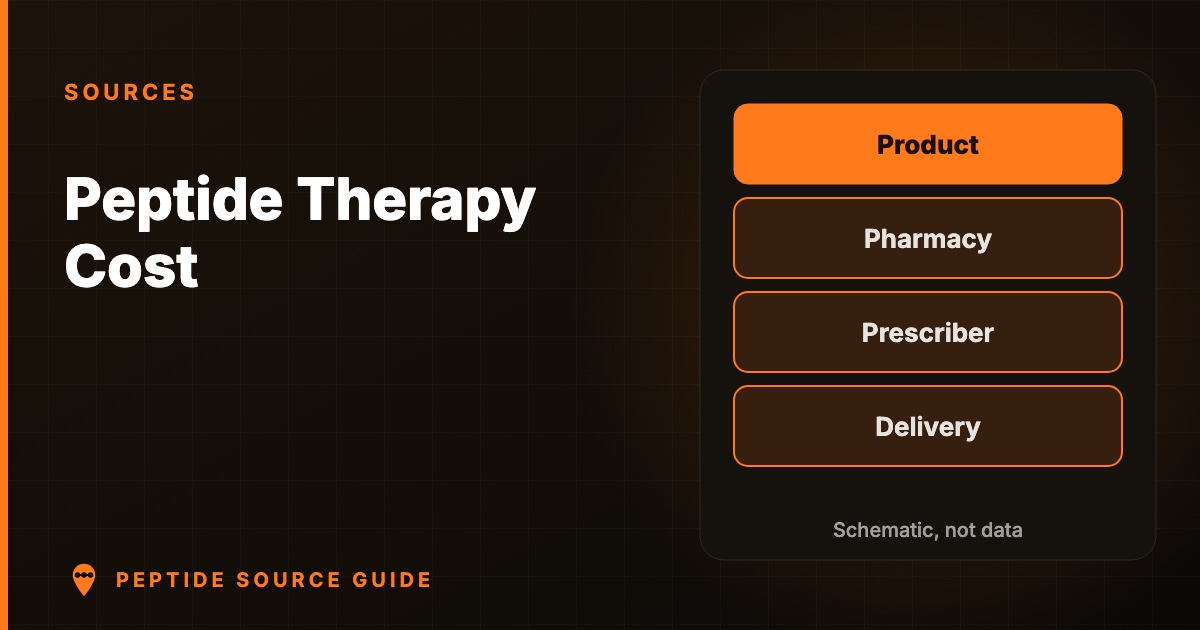
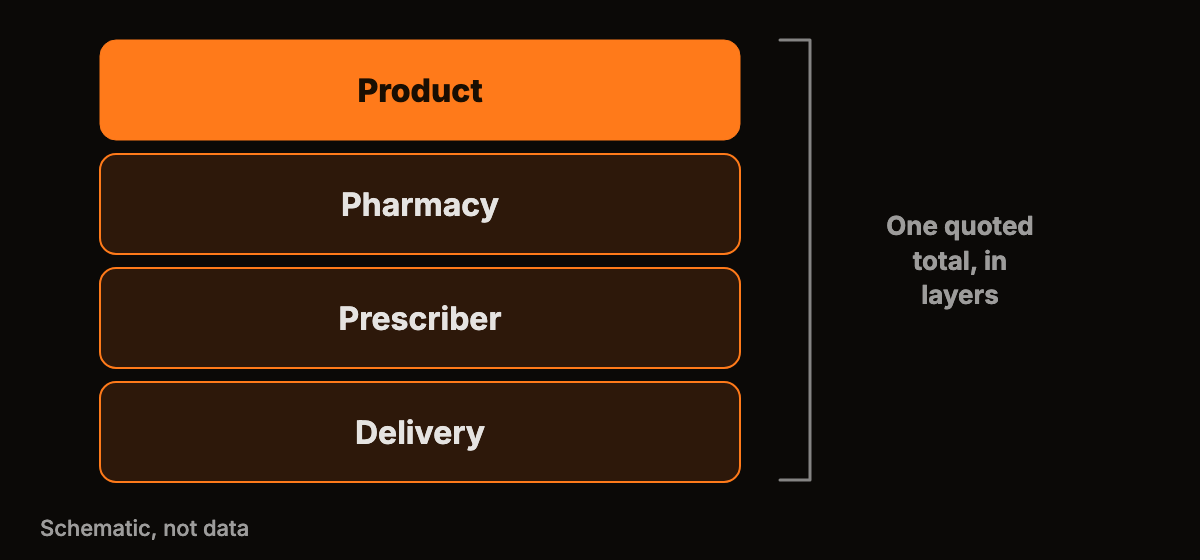
When a seller quotes one monthly number, several costs are folded into it. Knowing the layers lets you compare like with like.
- Ingredient. What is actually in the vial: an approved brand drug, a compounded preparation, or a bulk substance. FDA says compounded drugs are not reviewed for quality before marketing. An ingredient can be cheap because quality checks are thin. Ask for the source of the active ingredient.
- Preparation. Compounding and sterile preparation take facilities, testing and staff. FDA says 503A pharmacies are overseen mainly by state boards, and outsourcing facilities are held to current good manufacturing practice. A very low price can mean the work was not done or was done elsewhere.
- Prescriber. A licensed prescriber's review is a real cost. FDA's telehealth red flags include not requiring screening and a prescription from a licensed doctor, so a price with no prescriber in it is a signal, not a saving.
- Pharmacy. FDA says to fill a prescription at a state-licensed pharmacy. Ask which pharmacy, in which state, and whether it is licensed in yours.
- Shipping and storage. Some injectable products need cold handling. FDA recommends against using an injectable GLP-1 that arrives warm. Ask who bears the cost if a package arrives damaged.
- Monitoring. Follow-up visits, lab work and a way to reach a licensed clinician after the product arrives. FDA lists no licensed doctor to answer questions after receipt as a red flag.
- Renewal terms. Introductory prices, auto-renewal, minimum commitments and what happens if you pause. Lilly's own page shows how this works for an approved brand: a lower price is conditional on refilling within a set window.
Why "too good to be true" pricing is a warning sign
FDA's guidance on buying medicine online lists "deep discounts or prices that seem too good to be true" among the signs of an unsafe online pharmacy. FDA's GLP-1 page repeats the same item among its telehealth red flags. It is criterion 4 in our five criteria: no pressure pricing.
The reasoning is plain. A price below the cost of a licensed prescriber, a licensed pharmacy and quality checks means one of those is missing. FDA warns that medicines from unsafe sources may contain the wrong amount of the active ingredient or the wrong ingredient. Sellers of "research" products charge little because they carry none of these costs, and FDA's warning letters say those products are unapproved new drugs. See how to spot fake peptides.
What about Whoosh Wellness?
Whoosh Wellness is the one partner on this site for the prescription route. Whoosh's own pages show different prices, so we print none. Our review of Whoosh Wellness explains what we saw. As stated by Whoosh (read 2026-10-07), it offers compounded sermorelin, semaglutide and tirzepatide, plus NAD+, glutathione and a topical GHK-Cu product; it does not offer BPC-157, CJC-1295, ipamorelin, tesamorelin or retatrutide. Compounded medications are not FDA-approved. A licensed physician decides whether a prescription is appropriate, so there is no promise of approval. The right price to rely on is the one in your written quote, not one on a comparison page, including this one.

Questions for a written quote
Ask for these answers in writing, before you pay, from any seller.
- What exactly am I buying, and is its FDA status stated in plain words? If it was made by a compounding pharmacy, does the quote say so?
- What is the total for the first month, and what is the total for each month after? Does the price change after an introductory period?
- Does the price include the licensed prescriber's review, or is that a separate fee? What happens if the prescriber decides a prescription is not appropriate?
- Which state-licensed pharmacy dispenses it, and can I check that license with my state board of pharmacy?
- What is included for shipping, cold handling and replacement if a package arrives warm or damaged?
- What follow-up and lab work are included, and who answers questions after the product arrives?
- How does renewal work? Is it automatic, can I cancel in writing, and is there a minimum commitment?
- What is the refund policy if I am not prescribed anything?
- Is any product labeled "research use only" or "not for human consumption"? If so, stop. FDA says those labels do not make a product lawful.
If a seller will not answer in writing, that is information about the seller. Our peptide source checklist puts the same questions on one printable page.
Sources
- FDA: How to buy medicines safely from an online pharmacy page current as of 2025-01-02, read 2026-10-07
- FDA: FDA's concerns with unapproved GLP-1 drugs used for weight loss page current as of 2026-10-01, read 2026-10-07
- FDA: Compounding and FDA, questions and answers page current as of 2025-09-16, read 2026-10-07
- NovoCare: Wegovy self-pay information manufacturer page, undated, read 2026-10-07
- LillyDirect: Zepbound KwikPen manufacturer page, undated, read 2026-10-07
- KFF Health News, article on cheaper GLP-1 weight-loss drugs and the Medicare bridge, published 2026-05-06, read 2026-10-07
FAQ
How much does peptide therapy cost?
We could not find a solid third-party source for a general figure. The numbers online come from sellers. For approved brand drugs, manufacturers publish dated self-pay programs, which are summarized above.
Why do online quotes for the same peptide differ so much?
Because the products may not be the same. Ingredient quality, preparation, whether a prescriber and a state-licensed pharmacy are involved, shipping and renewal terms all change the price. A low quote can mean one of those layers is missing.
Is a very cheap price a red flag?
FDA lists deep discounts and prices that seem too good to be true as a warning sign when buying medicine online. It is one signal, to be read with the other four criteria.
Does insurance cover peptides?
We found no source for that, and coverage depends on the plan and the product. For approved brands, manufacturer pages mention insurance programs with their own terms. Ask your plan in writing.
Do you print a price for Whoosh Wellness?
No. Whoosh's own pages show different prices, so any figure we printed could be wrong. Ask for a written quote and compare it with the questions above.
Are manufacturer prices permanent?
No. Both manufacturer pages we read say the program can change, and one says terms can change without notice. Read any figure here as a snapshot read on 2026-10-07.
Not medical advice. See the medical disclaimer.