Quick answer: "Peptide therapy" is a marketing phrase, not a term we found defined in the FDA pages we read (as of 2026-10-07). A peptide is a short chain of amino acids. FDA's rule draws its line at 40: a chain longer than that counts as a protein. Some peptide drugs are FDA-approved. Many peptides sold by clinics and websites are not, and compounded medications are not FDA-approved.
Peptides are real molecules, and some are real, approved medicines. The trouble starts when one phrase covers an approved brand drug, a pharmacy-made copy and a vial with a research label. This page sorts them. Some links elsewhere on this site are affiliate links; there are none on this page.
What a peptide is
A peptide is a chain of amino acids, the same building blocks that make up proteins. The difference is length and complexity. In its final rule on the definition of a biological product (Federal Register, 2020-02-21), FDA defined a protein as an amino acid polymer with a specific, defined sequence that is "greater than 40 amino acids in size." The rule took effect on 2020-03-23, and the text is codified at 21 CFR 600.3(h)(6).
The same rule says the definitions FDA reviewed are "clear that 'peptides' are distinct from 'proteins'," and that a peptide generally means a smaller, simpler chain. Our reading, which is not an FDA sentence: a chain of 40 or fewer amino acids is not a protein under that rule. We did not find FDA stating it in those words.
Chain length matters in practice. FDA's staff briefing on BPC-157, dated 2026-05-11, describes it as "reported to be comprised of 15 amino acids." Semaglutide and tirzepatide are peptide drugs too. Insulin and growth hormone are proteins, which is part of why they are regulated differently, and FDA's compounding page says biological products are not eligible for the exemptions that cover pharmacy compounding.
Is "peptide therapy" a defined term?
We looked for a definition and did not find one. In the FDA pages we read, no sentence defines "peptide therapy." We also found no FTC order or statement specifically about it, and no statement from ASHP. That is an absence in the pages we read, not proof that none exists. What FDA does describe is the market. Its staff briefing on ipamorelin (meeting of 2024-10-29) says formulations are "increasingly being marketed by medical spas and wellness clinics."
News coverage uses the same loose grouping. NPR reported on 2026-03-26 that providers include high-end clinics, large wellness chains, med spas and websites. The phrase tells you a business model, a clinic or an online service selling injectable or oral peptides, and tells you nothing about whether a given product is approved, how it was made or what evidence supports it.
So the useful question is never whether something counts as "peptide therapy." It is what the specific product is, who makes it and what FDA says about it.
Approved drug, unapproved ingredient, or supplement?
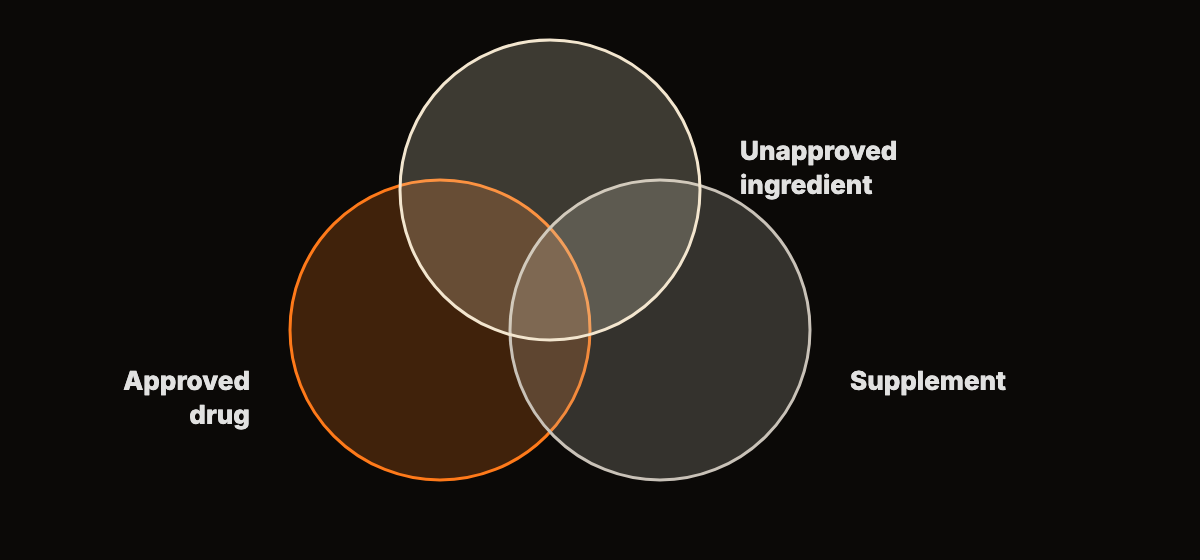
Almost every product sold under the "peptide therapy" label falls into one of three groups. Ask which one before you read anything else on the page.
| Group | What it means | Examples | What you can check |
|---|---|---|---|
| Approved drug | FDA reviewed an application and approved a specific product with a label | Wegovy, Zepbound, Mounjaro, Egrifta WR (labels read 2026-10-07) | Drugs@FDA and the DailyMed label |
| Unapproved ingredient | Not an approved product. Often a pharmacy-made copy, or a vial sold with a research-use label. Compounded medications are not FDA-approved | Compounded versions of approved peptides; BPC-157, CJC-1295 and ipamorelin products | FDA's compounding category lists and its safety-risks page |
| Supplement | Sold as a dietary supplement rather than a drug | BPC-157 capsules and tablets, as FDA's briefing describes the market | The product label; FDA's statements; the seller's claims |
As of 2026-10-07. Sources: DailyMed labels; FDA safety-risks page current as of 2026-04-22; FDA BPC-157 briefing dated 2026-05-11.
Approved drug. The approved peptide drugs include the semaglutide, tirzepatide and liraglutide brands, tesamorelin (Egrifta WR), teriparatide, octreotide, bremelanotide and setmelanotide. Each has a label that states what it is approved for, and each label lists risks. The full dated table is on FDA-approved peptides. Approval is specific to a product and its stated uses. An approved peptide does not make a different product with the same ingredient approved.
Unapproved ingredient. This is the largest group. It includes pharmacy-made copies of approved drugs, products made from bulk substances that FDA has put into one of its interim categories, and vials sold online. FDA's compounding page says compounded drugs are not FDA-approved and that FDA does not verify their safety, effectiveness or quality. The details of how that works are in compounded peptides. Where a product is sold with a research-use label, FDA's warning letters say the label does not change the product's intended use. See research peptides explained.
Supplement. FDA's staff briefing says BPC-157 is "marketed in the United States as an ingredient in dietary supplement products," as oral capsules and tablets. That sentence describes the market. The briefing does not state a legal conclusion about supplement status, and neither do we. It also says BPC-157 is not a component of an FDA-approved drug.
How clinics use the phrase
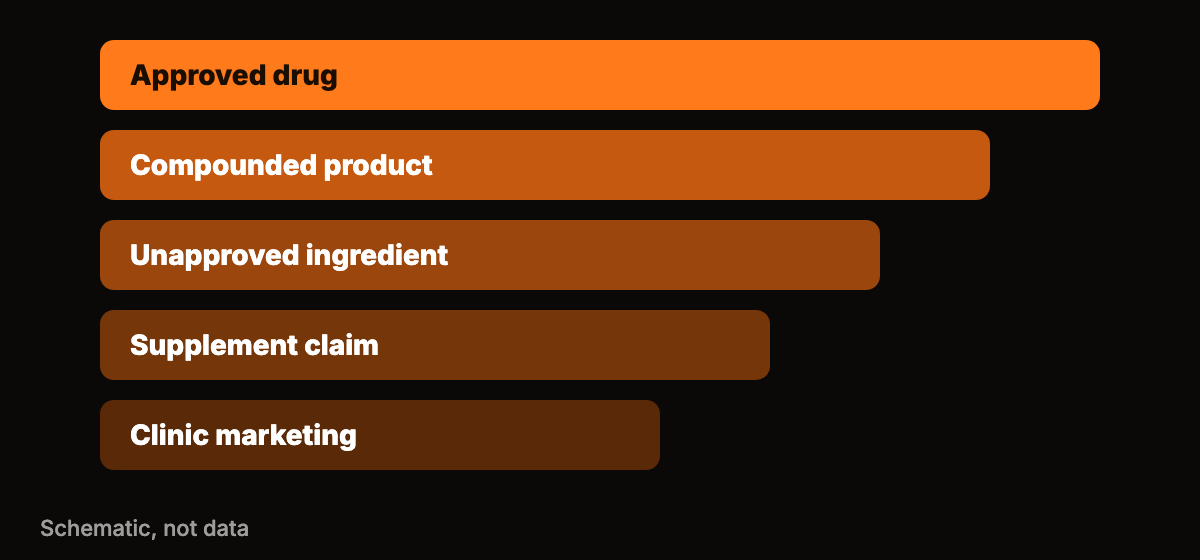
Read the word "therapy" with care. A clinic that sells a mix of products may use one banner for all of them. Three patterns are common.
A brand drug under a new heading. A clinic prescribes an approved brand and puts it under "peptide therapy." The product is FDA-approved, and the label governs it.
A compounded copy. A pharmacy makes a version of an ingredient to a prescriber's order. FDA says compounded drugs should only be used when an approved drug cannot meet a patient's medical needs, and it adds that they are not FDA-approved.
A substance with no approved product. The clinic offers BPC-157, CJC-1295 or ipamorelin. FDA's pages list these in its compounding documents, as we explain below, and none has an approved product.
The Endocrine Society's 2023 scientific statement on hormones and aging says "no therapy to increase GH secretion or action is approved as an anti-aging intervention." That statement is about growth hormone and its secretagogues in aging, not about every clinic. It is useful as a dated, independent check on one popular marketing theme.
What FDA's own documents say about popular names
FDA's safety-risks page (current as of 2026-04-22) lists BPC-157, TB-500 and CJC-1295 in its table of substances "nominated but withdrawn." Those were previously in Category 2 and were withdrawn by the nominators. FDA still prints its safety concerns for them. Ipamorelin acetate sits in an active Category 2 entry for outsourcing facilities (503B), added 2023-09-29.
For BPC-157, FDA staff wrote in a briefing dated 2026-05-11 that the evaluation criteria "weigh against" placing it on the 503A bulks list. The advisory committee met on 2026-07-23 and 2026-07-24. We did not find FDA's published outcome as of 2026-10-07, so we make no claim about the vote.
WADA's 2026 Prohibited List names BPC-157 in its non-approved substances class and CJC-1295 and ipamorelin among growth hormone releasing factors and secretagogues. FDA's BPC-157 briefing also notes the WADA listing. Athletes who are tested should read the list itself before using any of these products.
What regulators and boards have said about clinics
The Ohio State Board of Pharmacy published a document titled "Ten Common Prescriber Clinic and Medical Spa Violations" (updated 2025-12-08). It says the board had summarily suspended "more than 30 clinics and medical spas" since the start of 2025. It also says a drug labeled for research purposes only is unlawful for prescriber clinics and med spas to possess. That document predates FDA's April 2026 changes to its Category 2 table, so we do not rely on its sentence about BPC-157, and it speaks only for Ohio.
It shows something general: a state board of pharmacy, not FDA, is often the day-to-day regulator of a clinic's pharmacy supply. FDA's compounding page says state boards of pharmacy have primary day-to-day oversight of the pharmacies that compound outside the outsourcing-facility category.
How to read a clinic's claims
A short sequence works for any clinic or website:
- Name the product. If the page says only "peptide protocol" or "peptide blend," ask for the exact ingredient and its FDA status in writing.
- Ask whether it is an approved brand or compounded. Compounded medications are not FDA-approved, and a seller who describes a compounded drug as "the same as" an approved one is on FDA's red-flag list.
- Find the prescriber and the pharmacy. FDA's safe-signs list asks for a licensed prescriber and a state-licensed pharmacy.
- Check the language of the claims. FDA's warning letters count statements such as "research shows" next to a product as evidence of what it is meant for.
- Check the price pressure. Deep discounts, countdowns and coupon urgency are FDA warning signs.
Our five criteria in order: a licensed prescriber reviews you; a state-licensed US pharmacy dispenses it; the product's FDA status is stated plainly; no pressure pricing; and no "research use only" or "not for human consumption" label on a product meant for people. How to choose a peptide company explains each, and peptide side effects covers what labels and agency documents report.
Sources
- Federal Register: Definition of the Term "Biological Product" (2020-02-21) read 2026-10-07
- eCFR: 21 CFR 600.3 section version dated 2020-03-24, read 2026-10-07
- FDA: BPC-157 briefing document memo dated 2026-05-11, read 2026-10-07
- FDA: Ipamorelin briefing document memo dated 2024-08-19, read 2026-10-07
- FDA: Certain bulk drug substances that may present significant safety risks page current as of 2026-04-22, read 2026-10-07
- FDA: Compounding and FDA, questions and answers page current as of 2025-09-16, read 2026-10-07
- FDA: Telehealth companies, what to know when promoting compounded drugs page current as of 2026-06-15, read 2026-10-07
- FDA: Concerns with unapproved GLP-1 drugs used for weight loss page current as of 2026-10-01, read 2026-10-07
- Endocrine Society scientific statement, Hormones and Aging (2023) read 2026-10-07
- Ohio State Board of Pharmacy, Ten Common Prescriber Clinic and Medical Spa Violations, updated 2025-12-08, read 2026-10-07 (not linked here)
- NPR, report on peptide clinics, published 2026-03-26, read 2026-10-07 (not linked here)
FAQ
What is peptide therapy?
It is a marketing phrase for services that sell peptides, which are short chains of amino acids. We found no FDA definition of it as of 2026-10-07. What matters is the product: an approved drug, a compounded copy or a substance with no approved product.
How long is a peptide, by FDA's rule?
FDA's 2020 rule defines a protein as a chain "greater than 40 amino acids in size." By our reading, a chain of 40 or fewer is not a protein under that rule. FDA did not state it in those words.
Are peptide drugs FDA-approved?
Some are. The approved list includes semaglutide, tirzepatide and liraglutide brands, tesamorelin, teriparatide, octreotide, bremelanotide and setmelanotide. Many popular peptides, such as BPC-157, CJC-1295, ipamorelin and TB-500, have no FDA-approved product.
Is BPC-157 a supplement?
FDA's staff briefing says it is marketed in the United States as an ingredient in dietary supplement products, and it also says BPC-157 is not a component of an FDA-approved drug. The briefing states no legal conclusion on supplement status.
Does a clinic's prescription make a peptide approved?
No. A prescription is a clinician's order. Approval belongs to a product. Compounded medications are not FDA-approved even when a licensed pharmacy fills a valid prescription.
Is peptide therapy regulated by a state?
State boards of pharmacy oversee pharmacies, and the Ohio board has acted against clinics and medical spas. Rules differ by state, so check your own board. FDA still regulates drugs at the federal level.
Not medical advice. See the medical disclaimer.