Quick answer: Judge any peptide seller on five checks: a licensed prescriber reviews you, a state-licensed US pharmacy dispenses the product, its FDA status is stated plainly, there is no pressure pricing, and no "research use only" label sits on a product meant for people. FDA lists four safe signs, and criteria 3 to 5 are our own picks drawn from other FDA pages. Compounded medications are not FDA-approved.
People who search for the best peptide companies are usually asking a question that has no ranked answer, because FDA does not rank sellers and neither do we. What we can offer is a test you can run yourself in about ten minutes with a browser. Some links on this site are affiliate links; this page has no button, and a licensed physician decides whether any prescription is appropriate.
What FDA publishes, and what we added
The method matters more than the result, so we state it first.
FDA's consumer update on buying medicines online lists four signs of a safe online pharmacy. The signs are a prescription every time, a US street address with a telephone number, a pharmacist holding a license on staff, and a license from the state's pharmacy board. Four signs, not five.
Our criteria 1 and 2 follow those signs. They merge the prescription sign into criterion 1 and the pharmacist and state-board signs into criterion 2. We did not make the US address and telephone number a separate criterion, but you should still look for them. Criteria 3, 4 and 5 are ours. We took them from other FDA pages: its compounding Q&A and its GLP-1 page for criterion 3, its warning signs for online pharmacies for criterion 4, and its warning letters for criterion 5. FDA has not published these five as a checklist, and nothing here is an FDA endorsement of any seller.
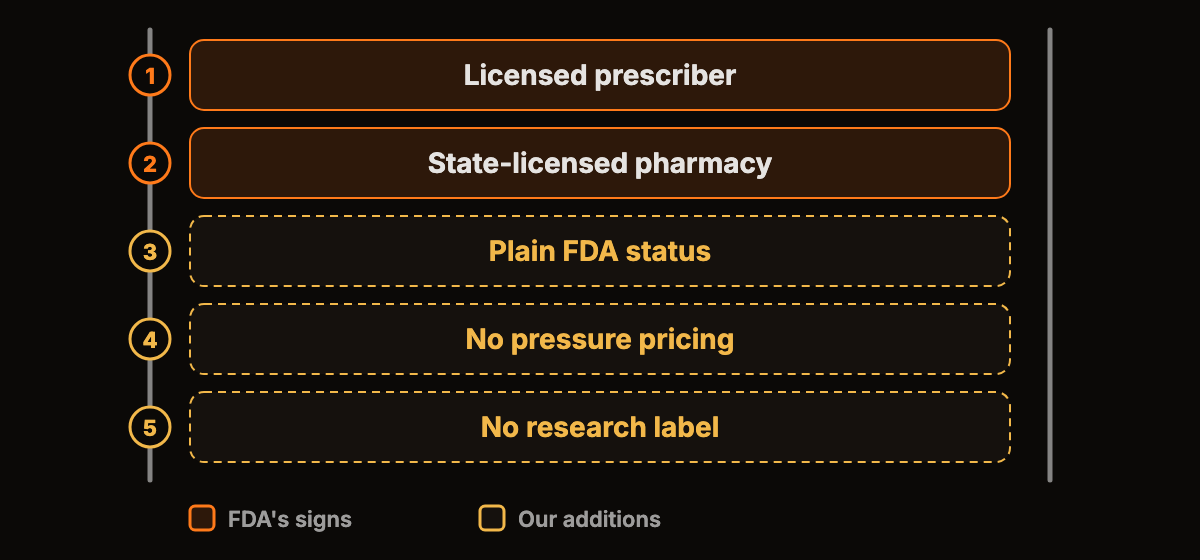
The five criteria
1. A licensed prescriber reviews you
Why it matters. FDA's first safe sign is that the pharmacy always requires a doctor's prescription. A peptide product that arrives without anyone reviewing your history has skipped the step that a pharmacy license depends on. The GLP-1 page also warns about sellers that provide medicine with no screening by a licensed doctor first.
How to check it yourself.
- Look for a statement that a licensed clinician reviews each request, and for a way to reach that clinician after you receive the product. FDA lists the absence of a licensed doctor to answer questions as a warning sign.
- Ask in writing for the prescriber's name and the state where that person is licensed. A service that cannot or will not answer has told you something.
- Notice what is asked. A real review asks about medical history, medicines you take and conditions you have. A form that asks only for a shipping address and payment is not a review.
- Remember that a review is not a promise. Any honest service says a prescription may be declined.
2. A state-licensed US pharmacy dispenses it
Why it matters. Two of FDA's signs concern the pharmacist and the state board license. FDA's compounding Q&A says state boards of pharmacy have primary day-to-day oversight of pharmacies that are not outsourcing facilities. A license is the one part of a pharmacy that outsiders can look up.
How to check it yourself.
- Ask which pharmacy fills the order. Many telehealth services use a partner pharmacy and name it in a FAQ, on a label, or when you ask.
- Search for the pharmacy in FDA's BeSafeRx location tool, which looks in state board databases. FDA's advice is to avoid an online pharmacy the tool does not list.
- Check that the pharmacy is licensed in your state. A pharmacy may be licensed in many states and still not in yours; ask for the list.
- Look for a US physical address and telephone number, FDA's other safe sign.
3. The product's FDA status is stated plainly
Why it matters. Whether a product is an approved brand drug or a compounded drug changes what FDA has reviewed. FDA's compounding Q&A says compounded drugs are not FDA-approved and that FDA does not verify their safety, effectiveness or quality. It also says compounded drugs should be used only by patients whose medical needs cannot be met by an approved drug. FDA's GLP-1 page lists a claim that a compounded drug "is the same as" an approved one as a warning sign.
How to check it yourself.
- Find the sentence. A seller that is straightforward about status says it near the product, not only in a terms page. If you have to dig through legal text to learn that a product is compounded, that is information.
- Ask: is this the brand product, or is it made by a compounding pharmacy? If the answer is the second, ask whether the pharmacy is a 503A pharmacy or a 503B outsourcing facility.
- For approved drugs, search the brand name on DailyMed, which carries the labels FDA has on file. An approved brand drug has a label there; a product you cannot find is a reason to ask more questions.
- For popular peptides without approval, read which peptides are approved drugs and what compounding means.
- Be skeptical of words like "pharmaceutical grade" and "FDA-registered." FDA registration of a facility is not approval of a product.
4. No pressure pricing
Why it matters. FDA's page on buying from online pharmacies lists "deep discounts or prices that seem too good to be true" as a warning sign. Pressure of any kind, such as a discount that expires or a code you must enter, moves the decision away from the five checks and toward the price.
How to check it yourself.
- Open the page twice, a day apart. A deal that changes only because a timer says it should is pressure, not pricing.
- Compare the price on the product page, in the cart and in the written plan, including renewal terms. Prices that differ between pages are a sign to stop and ask.
- Take any coupon code that appears in a pop-up as a reason to read the terms more slowly.
- Ask what happens if you cancel, and whether auto-renewal is stated before you pay.
5. No "research use only" or "not for human consumption" label on a product meant for people
Why it matters. In FDA's warning letters, a label like that does not settle what a product is meant for; what the seller says and shows does. A product that carries the label, and also carries claims about the body, is the pattern FDA wrote to sellers about on 2026-03-31. A buyer gets the worst of both: a product no one has reviewed, with a label that says no one is responsible.
How to check it yourself.
- Read the label on the product page and the checkout. If a product is meant to be used by people, it should arrive as a prescription product from a pharmacy, with a prescription label.
- Look at what else the page says. Instructions, calculators or guides for preparing a product for injection, or claims about weight, appetite or recovery, are the kind of evidence FDA cited in its letters.
- Notice whether the seller sells a diluent or syringes beside the product. FDA's August 2026 letters cite that pairing.
- If the page tells you the product is for laboratories while behaving like a store, close it.
Applying the five checks to the service we feature
We feature one service, Whoosh Wellness, through an affiliate link on other pages. This table applies the criteria to it using only what it says on its own pages, read on 2026-10-07. The labels STATED, NOT STATED and MIXED describe what we found. They are not a grade, and we have not tested its products or its pharmacy.
| Criterion | Why it matters | Whoosh as stated by Whoosh (read 2026-10-07) | How you can check it yourself |
|---|---|---|---|
| 1. Licensed prescriber | FDA's first safe sign | STATED A licensed physician reviews the intake, as Whoosh describes it | Request the prescriber's name and license state |
| 2. State-licensed US pharmacy | FDA's pharmacist and state-board signs | STATED A partner pharmacy in Ohio is named in its FAQ. CAN'T BE CHECKED BY US: whether the license is current | BeSafeRx location tool; confirm your state is covered |
| 3. FDA status stated plainly | FDA says compounded drugs are not FDA-approved | STATED on most pages, including the terms; one page we read lacks it | Find the status sentence before paying |
| 4. No pressure pricing | FDA names deep discounts as a warning sign | MIXED A first-order discount pop-up is on its home page; we found no countdowns; its pages give different prices | Compare the product page, cart and written plan |
| 5. No research-use label | FDA letters on intended use | STATED Whoosh describes research chemicals as not approved for human therapeutic use | Read the label and the product page |
As of 2026-10-07. Whoosh's statements are its own. For the longer reading, including where its pages disagree, see the Whoosh Wellness review.
What the checks cannot do
A passing score on these five checks tells you that a seller follows the route FDA describes. It does not tell you the product works, that it is right for you, or that a given batch is pure. FDA says compounded drugs are not FDA-approved and that it does not verify their quality, so an honest seller cannot tell you that FDA has checked a compounded product either.
The checks also say nothing about a prescriber's judgment. That is why FDA's safe signs begin with a prescription from a licensed doctor and why your own doctor remains an option: where peptides come from describes the second route in full.
Finally, status changes. FDA's lists of bulk substances, its GLP-1 page and its safety page have all been updated within the last year. For each fact we cite a page and the date it says it was current. Check the page again before you buy.
A short checklist to print
The one-page checklist turns these five checks into ten questions to ask a seller. The questions that matter most before any payment are these: who is the prescriber, which pharmacy fills the order and where is it licensed, what is the product's FDA status in plain words, what is the written price including renewal, and how do I cancel.
If a seller answers all five in writing, you have the information FDA's safe signs call for. If it answers some and avoids others, you have learned what you needed.
Sources
- FDA: How to buy medicines safely from an online pharmacy page current as of 2025-01-02, read 2026-10-07
- FDA: Considering an online pharmacy (BeSafeRx) page current as of 2020-09-21, read 2026-10-07
- FDA: Compounding and the FDA, questions and answers page current as of 2025-09-16, read 2026-10-07
- FDA: Concerns with unapproved GLP-1 drugs used for weight loss page current as of 2026-10-01, read 2026-10-07
- FDA warning letter dated 2026-03-31 page current as of 2026-04-07, read 2026-10-07
- FDA warning letter dated 2026-08-24 read 2026-10-07
- Whoosh Wellness home, FAQ, pharmacy-standards, pricing, terms and research-vs-prescribed pages, read 2026-10-07
FAQ
What are the best peptide companies?
FDA does not rank them and neither do we. We offer five checks: a licensed prescriber, a state-licensed US pharmacy, plain FDA status, no pressure pricing and no research-use label. A company that meets all five as it states them is worth a closer look.
Does FDA publish a five-point checklist?
No. FDA publishes four safe signs for online pharmacies. Criteria 1 and 2 follow those signs; criteria 3 to 5 are our selection from FDA's compounding, GLP-1 and warning-letter pages.
How do I check whether a pharmacy is licensed?
Use FDA's BeSafeRx location tool, which checks state board of pharmacy databases. FDA advises against using any online pharmacy the tool omits.
Is a company "FDA-registered" the same as FDA-approved?
No. Registration of a facility and approval of a product are different things. FDA's compounding Q&A says compounded drugs are not FDA-approved, and a registered facility can still make a compounded drug.
Does a certificate of analysis make a seller trustworthy?
Not by itself. A certificate is a document supplied by the seller or by a lab the seller chose. Our page on how to spot fake peptides covers what such a document can and cannot show.
Do you recommend a company?
We feature one service through an affiliate link, and we say what it states about itself against the five checks. That is not a verdict, and a reader can run the same checks on any other seller.
Not medical advice. See the medical disclaimer.