Quick answer: FDA does not publish a checklist for spotting fake peptides, but its pages on unsafe online pharmacies, its GLP-1 warnings and its warning letters describe signs that repeat: no prescription asked for, deep discounts, labels with errors, products that arrive warm, and research labels beside human-use claims. A certificate of analysis tied to a batch can show something, but it cannot show that it belongs to the vial you hold.
"Fake" covers several different problems. A counterfeit copies an approved brand. A mislabeled product carries the wrong name or the wrong amount. An unapproved product is real in the sense that it contains something, but nobody with accountability has verified what. FDA's pages describe all three, and they overlap. Some links on this site are affiliate links; none appear on this page, and we name no sellers or laboratories.
This page does two jobs. First, a red-flag list, each item with the reason it matters and its source. Second, an editorial explanation of what a certificate of analysis, usually shortened to COA, can and cannot show. The first draws on FDA's own wording; the second is our reasoning.
How to use the list
FDA publishes four signs of a safe online pharmacy: a required prescription, a US address and phone number, a pharmacist on staff, and a state board license. Everything below is either a mirror image of those four or a sign taken from FDA's other pages. Our five-point seller check, in how to choose a peptide company, builds on the same material. Criteria 3 to 5 are our selection from FDA's other pages, not an FDA checklist.
Passing every flag below does not make a product safe. It only means the listing does not show the warning signs FDA describes. Compounded medications are not FDA-approved, and a product with no flags may still be unapproved.
Red flags in a listing or a seller
- Nobody asks for a prescription. FDA lists a seller that never asks for one among the warning signs of an unsafe online pharmacy, and says safe pharmacies always require a doctor's prescription. (FDA consumer update on buying medicines safely online, current as of 2025-01-02)
- No US address or telephone number. FDA says a safe online pharmacy provides a physical address and telephone number in the United States. Without them, you cannot tell who answers for the product. (FDA BeSafeRx, "Considering an online pharmacy")
- No licensed pharmacist on staff, or no state license. FDA says to check the pharmacy's license in the state board database through its BeSafeRx tool, and that if the pharmacy is not listed, do not use it. (FDA consumer update, current as of 2025-01-02)
- Deep discounts or prices that seem too good to be true. FDA names this as a warning sign for online pharmacies and again among its telehealth red flags for GLP-1 drugs. A price far below the market raises the question of what is in the vial. (FDA consumer update; FDA GLP-1 page, current as of 2026-10-01)
- Claims that a compounded drug "is the same as" an approved drug. FDA lists such claims as a red flag, because compounded drugs are not FDA-reviewed and an approved drug is. (FDA GLP-1 page, current as of 2026-10-01)
- No screening by a licensed doctor, or no licensed doctor to answer questions afterward. FDA lists both among telehealth red flags. (FDA GLP-1 page)
- A label with spelling errors, or a pharmacy address that does not match. FDA lists both, and says that in some cases the compounding pharmacies named on labels "do not exist." Other labels carry the names of real pharmacies that did not compound the product. (FDA GLP-1 page)
- Medicine that looks different from what you expected. FDA warns about medicine that looks different from what a local pharmacy gave or what the website pictured, and about packaging that is broken, damaged, in a foreign language, or missing an expiration date or instructions. (FDA consumer update; FDA GLP-1 page)
- A package that arrives warm. FDA says it has received complaints of compounded GLP-1 products arriving warm or with inadequate ice packs, and recommends not using an injectable that "arrives warm or with insufficient refrigeration." (FDA GLP-1 page)
- A product described as compounded that FDA says cannot be compounded. FDA says retatrutide and cagrilintide "cannot be used in compounding under federal law." A listing for a compounded version contradicts FDA's page. (FDA GLP-1 page)
- A different salt form presented as the same drug. FDA says semaglutide sodium and semaglutide acetate are different active ingredients and that it is not aware of a lawful basis for their use in compounding. (FDA GLP-1 page)
- Product names that do not match the ingredient. In a letter dated 2026-03-31, FDA's own text notes a seller labeling one drug as a different peptide class. A name on a vial that disagrees with the ingredient is a labeling failure. (FDA warning letter dated 2026-03-31)
- Charges for products you never ordered, or a seller that sells your information. FDA lists both as warning signs. (FDA consumer update)
- A research or "not for human consumption" label beside claims aimed at people. FDA's warning letters say such labels do not change a product's intended use when the seller's website shows human use. See research peptides explained. (FDA warning letters dated 2026-03-31)
- Study summaries or "research shows" text used as a sales pitch. FDA's letters dated 2026-06-17 and 2026-08-24 count such passages as drug claims. (FDA warning letters)
- A diluent, syringes, a calculator or a guide sold with the product. FDA's letters cite these as evidence that the product is meant for injection into people. (FDA warning letters dated 2026-03-31 and 2026-08-24)
- Goods shipped from abroad under another description. A customs release dated 2026-03-31 says about 5,000 peptide shipments were declared as other goods, and that the "authenticity of the products and safety of these peptides cannot be determined." (CBP release, Cincinnati)
- Countdowns, coupon-code urgency and "limited" stock. FDA's pages do not list these by name, so this one is our selection under criterion 4, no pressure pricing, and is not an FDA statement. We include it because deep-discount pressure is on FDA's list and urgency is its usual companion. (Our editorial selection; related FDA wording above)
As of 2026-10-07. FDA pages are updated, so open each source for its current text.
What FDA says can go wrong
FDA's GLP-1 page says illegally marketed products sold online "may be counterfeit," "could contain the wrong ingredients," and could contain too little, too much or no active ingredient at all. It adds that counterfeit Ozempic is on the US market. FDA's BeSafeRx update says drugs from unsafe pharmacies may not contain the right active ingredient, or may contain harmful ones.
What a certificate of analysis can and cannot show
This section is editorial. We are explaining how a document works, not reporting an FDA position. We did not find an FDA page that evaluates or endorses certificates supplied by sellers of peptides at retail, and we do not claim that FDA addresses them.
What the document could show
A certificate of analysis is a report from a testing laboratory about a sample from a batch. In principle, a well-made one can state:
- the name of the substance tested and the batch or lot identifier;
- the test methods used and the date of testing;
- a purity figure and the impurities the method detected;
- the identity of the laboratory and whoever signed the report.
Those are real pieces of information, and they matter in the one place where FDA does require them. Under section 503A and FDA's pages on bulk substances, a pharmacy or outsourcing facility that compounds a drug must obtain a valid certificate of analysis for the bulk substance it uses, and the substance must come from an establishment registered with FDA. That requirement applies to a compounder's ingredients. It is not a standard for retail vials, and it comes with legal accountability that a retail listing does not.
FDA's briefing document for its July 2026 advisory committee shows how a certificate can fail even in that setting. It notes that for one peptide, the nominators' certificates were not consistent with the substance they had nominated. A certificate is a claim about a sample, and it can disagree with the name on the paperwork.
What it cannot show
A certificate describes a sample, and the questions that matter to a buyer are about the product in the box. Here is where the gap opens.
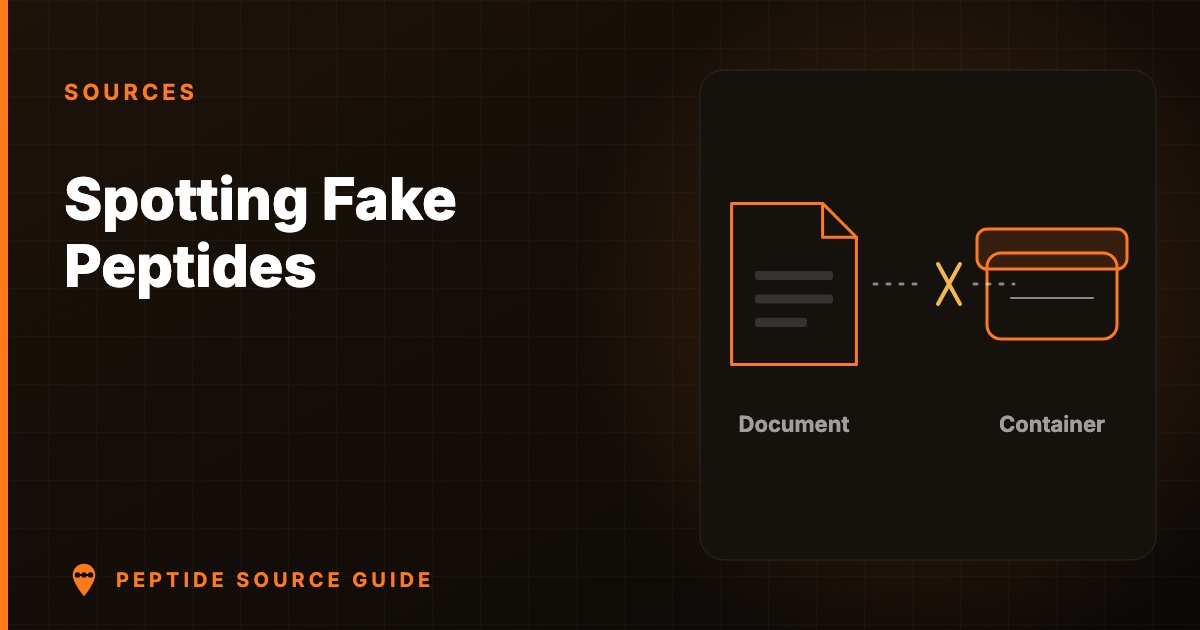
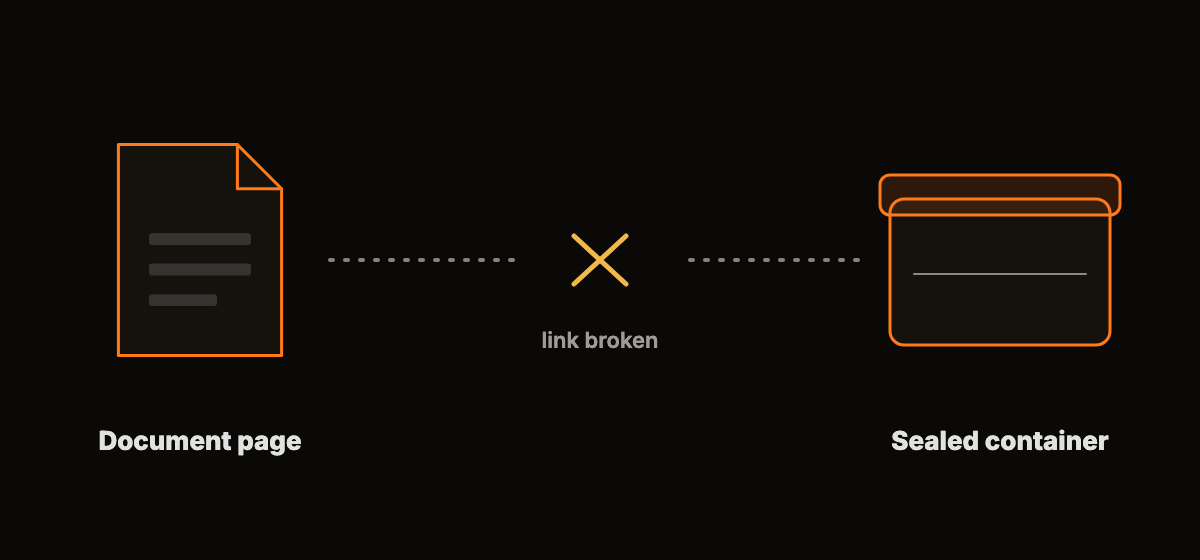
- It cannot show that it belongs to your vial. A lot number printed on a PDF is only text. Nothing in the document ties it to the container in your hand, unless an accountable party controls the link from test to label to shipment.
- It cannot show that the testing was independent. The report may come from a lab the seller chose, paid and could replace. A named laboratory is not the same as a verifiable one.
- It cannot show what was not tested. A report that gives identity and purity says nothing about sterility, bacterial toxins or other contaminants unless those tests are listed. FDA's concern about injectable products, as its letters put it, is that they "bypass some of the body's key defenses against toxins and microorganisms."
- It cannot show that later batches match. A listing may display one report while the stock changes. The date and the batch are the only clues.
- It cannot show how the product was stored or shipped. FDA's warning about products that arrive warm concerns what happens after any test.
- It cannot show that the document is genuine. A document is easy to copy, edit or attach to another listing. This is a limit of the format, not an accusation against any seller.
- It cannot supply an approval. A purity result does not make a product approved, prescribed or lawful to sell for human use. In the letters we read, FDA points to the seller's claims and presentation as the evidence of status, and none mentions a certificate.
Signs a certificate is meaningless
Without naming anyone, these are the patterns that make a certificate close to useless as evidence: no batch identifier, a batch that does not match the product, no testing date, a laboratory with no way to reach it, one generic file shown for many products, or a document offered in place of a prescriber and a licensed pharmacy.
The last one deserves emphasis. Criterion 1, a licensed prescriber who reviews you, and criterion 2, a state-licensed US pharmacy that dispenses it, cannot be replaced by paperwork about a vial. If a seller offers testing in place of those two, the two have not been met.
If you already hold a product you doubt
FDA's BeSafeRx pages say unsafe online pharmacies can be reported to FDA, and adverse effects can be reported to MedWatch. For anything beyond that, such as how to handle a product you already have, talk with a licensed pharmacist or clinician. For the legal background, see is it legal to buy peptides online, and for the safe-route options see where peptides come from.
Sources
- FDA: how to buy medicines safely from an online pharmacy page current as of 2025-01-02, read 2026-10-07
- FDA BeSafeRx: considering an online pharmacy page current as of 2020-09-21, read 2026-10-07
- FDA: concerns with unapproved GLP-1 drugs used for weight loss page current as of 2026-10-01, read 2026-10-07
- FDA warning letter dated 2026-03-31 page current as of 2026-04-07, read 2026-10-07
- FDA warning letter dated 2026-06-17 read 2026-10-07
- FDA warning letter dated 2026-08-24 read 2026-10-07
- CBP: Cincinnati CBP foils scheme to smuggle over 5,000 unapproved peptides release dated 2026-03-31, read 2026-10-07
- FDA: bulk drug substances used in compounding under section 503A page current as of 2026-05-14, read 2026-10-07
- FDA: bulk drug substances used in compounding under section 503B page current as of 2025-01-07, read 2026-10-07
- FDA: briefing document, Pharmacy Compounding Advisory Committee, 2026-07-23 and 2026-07-24 read 2026-10-07
FAQ
How can I tell if a peptide is fake?
You usually cannot tell from the product alone. FDA says counterfeit and wrongly labeled products look real enough that it points consumers to prescriptions filled at state-licensed pharmacies rather than to visual checks.
Does a certificate of analysis prove a peptide is real?
No. It describes a sample tested at a laboratory, and it cannot show that it belongs to the vial you hold, that the lab was independent, or that later batches match.
Does FDA say anything about retail certificates of analysis?
We did not find an FDA page that evaluates certificates supplied by sellers at retail. FDA does require compounders to obtain valid certificates for the bulk substances they use.
What is the most reliable sign of a legitimate seller?
FDA's four safe signs: a required prescription, a US address and telephone number, a licensed pharmacist on staff and a state board license. FDA also advises checking the license in the state database.
Is a low price a red flag?
FDA names "deep discounts or prices that seem too good to be true" as a warning sign for online pharmacies and for GLP-1 telehealth sellers.
Where do I report a suspicious seller?
FDA's BeSafeRx pages say unsafe online pharmacies can be reported to FDA, and adverse effects can be reported through MedWatch.
Not medical advice. See the medical disclaimer.