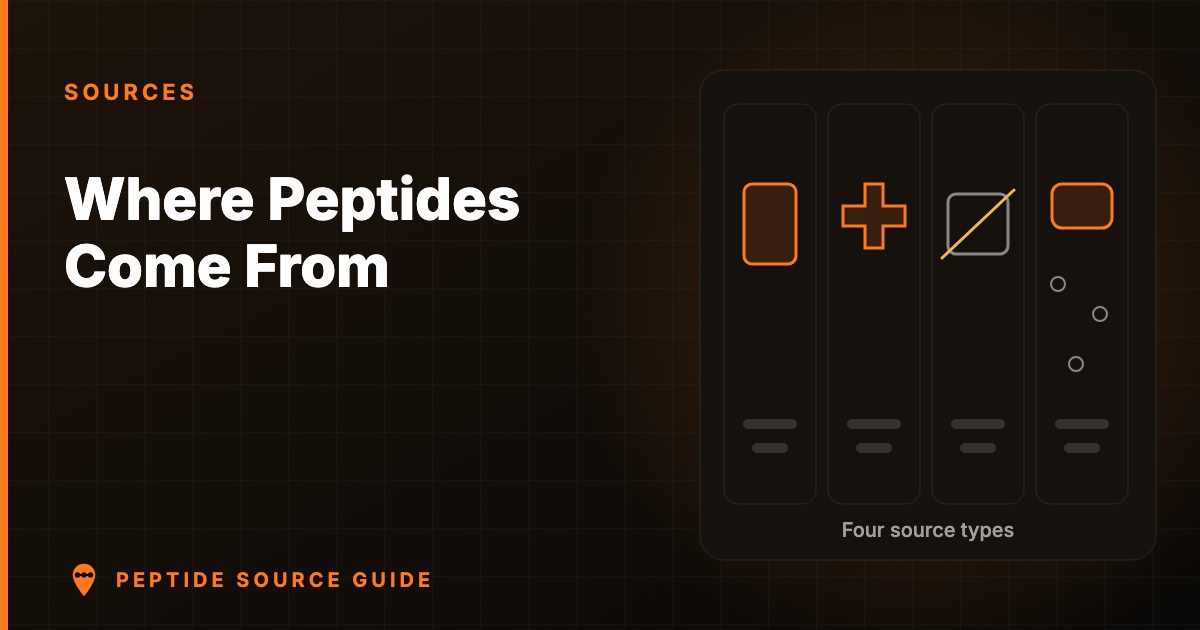
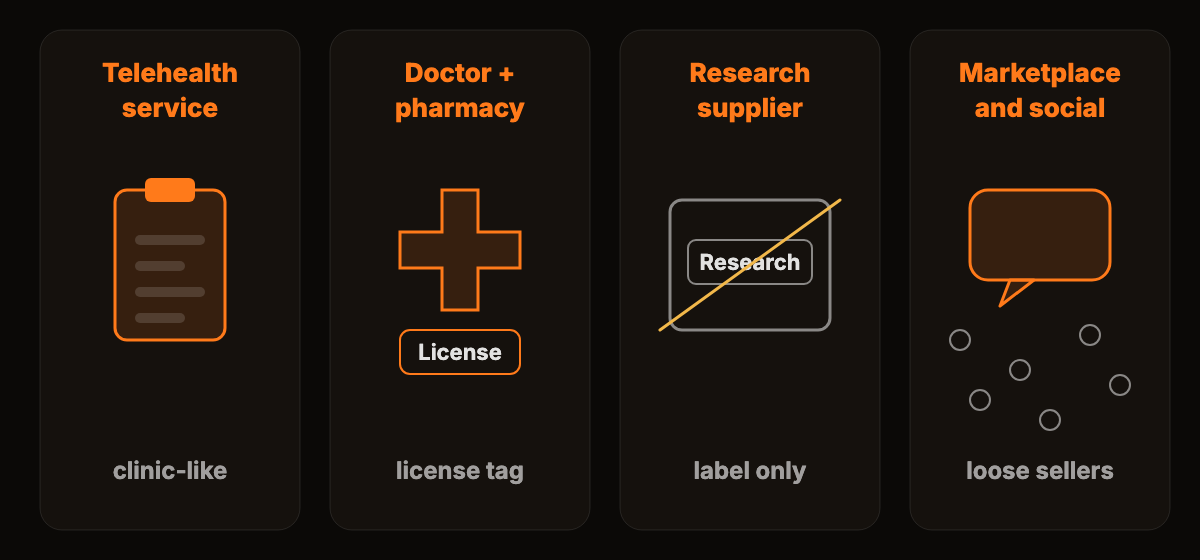
Quick answer: Peptides for sale in the US reach buyers through four kinds of source: a licensed prescriber's telehealth service, your own doctor plus a licensed pharmacy, "research use only" websites, and marketplaces or social sellers. Only the first two involve a prescription and a state-licensed pharmacy. FDA's warning letters call products from the third unapproved drugs, and compounded medications are not FDA-approved.
This page is the hub for the site. It sorts sellers into four types and, for each type, says who sells, what the law says, what you can verify and what the red flags are. Some links on this site are affiliate links; this page contains none, and a licensed physician decides whether any prescription is appropriate. Every status statement carries the date of the FDA page it comes from.
The four source types at a glance
Read the table first, then the section for the type you are weighing. The wording is deliberately plain: it reports what FDA and the statutes say, not what we would like them to say.
| Source type | Who dispenses | Prescription involved | FDA status of the product | What you can verify | Source |
|---|---|---|---|---|---|
| Telehealth service with a licensed prescriber | A licensed pharmacy the service works with | Yes, from a clinician who reviews your answers | Approved brand drugs carry FDA approval for stated uses. A compounded drug is not FDA-approved | Pharmacy license in a state board database; who the prescriber is | FDA BeSafeRx consumer update (page current as of 2025-01-02) |
| Your doctor and a licensed pharmacy | A pharmacy chosen with your doctor | Yes, from a clinician who knows your history | Same split between approved and compounded products | Pharmacy license; the dispensing label | FDA GLP-1 page (page current as of 2026-10-01) |
| Websites labeled "research use only" | The site that ships the vial, with no pharmacist reviewing your order | No | FDA's letters describe such products as unapproved new drugs | Only the seller's own claims | FDA warning letter dated 2026-03-31 |
| Marketplaces and social sellers | Unknown person or reseller, sometimes overseas | No | Not known, and FDA says products like these are of unknown quality | Very little; identity and storage history are hidden | FDA GLP-1 page; CBP release dated 2026-03-31 |
As of 2026-10-07. This is a summary of FDA, CBP and statute pages, not legal advice.
Source type 1: A licensed prescriber's telehealth service
Who sells. A telehealth company does not itself make or dispense the medication. It collects your answers, passes them to a licensed clinician, and, if that clinician writes a prescription, sends it to a pharmacy. The pharmacy ships the product. The company you see online is therefore the front door, and the pharmacy is the part FDA tells you to check.
What the law says. FDA's consumer update on buying medicines online sets out four signs of a safe online pharmacy: a required prescription, a US address and telephone number, a licensed pharmacist and a state pharmacy board license. Under the federal compounding statute, section 503A, a compounded drug must be made for an identified individual patient based on a valid prescription, by a licensed pharmacist in a state-licensed pharmacy or by a licensed physician. FDA's compounding Q&A is blunt about the result: compounded drugs are not FDA-approved, and FDA does not verify their safety, effectiveness or quality.
What you can verify. You can look up the pharmacy's license through FDA's BeSafeRx location tool. FDA's advice is to skip any online pharmacy the tool does not list. You can ask in writing for the prescriber's name, the pharmacy's name and where it is licensed, and whether you are getting a brand drug or a compounded one. You cannot verify the contents of a compounded product yourself.
Red flags.
- No clinician before shipment. FDA's GLP-1 page names a seller who ships medicine without first screening you and prescribing through a licensed doctor as a warning sign. (FDA GLP-1 page, current as of 2026-10-01)
- No licensed doctor to answer questions afterward. The same page lists this too. (FDA GLP-1 page)
- A claim that a compounded drug "is the same as" an approved drug. FDA lists such a claim as a warning sign, because compounded drugs are not FDA-approved. (FDA GLP-1 page)
- Prices that seem too good to be true. FDA's online-pharmacy page names deep discounts as a warning sign. (FDA consumer update, page current as of 2025-01-02)
- A pharmacy missing from the state board database. FDA advises against using it. (FDA consumer update)
One telehealth service is featured on this site, and our Whoosh Wellness review lists what it says and where its own pages disagree. We feature it because it describes a route that matches the first two of the five criteria in how to choose a peptide company, not because we tested it.
Source type 2: Your own doctor plus a licensed pharmacy
Who sells. Your doctor does not sell anything; the pharmacy does. This is the oldest route and the one FDA describes in its GLP-1 statement: get the prescription from your doctor, then fill it at a pharmacy licensed by the state.
What the law says. The same statutes apply as for telehealth. The difference is the relationship: a clinician who has examined you, knows your history and your other medicines, and can say no. Many peptide products have no FDA approval at all, so a doctor who is willing to prescribe one is relying on compounding rules, which allow only certain bulk substances to be used. FDA's page on 503A bulk substances says compounders may use a substance only if it meets a USP or NF monograph, is a component of an FDA-approved drug, or appears on FDA's 503A bulks list.
What you can verify. The pharmacy's license, the label on what arrives, and the brand name if the product is an approved drug. For approved drugs, the label on DailyMed lists the uses FDA has approved. For anything compounded, ask the pharmacy whether it is a 503A pharmacy or a 503B outsourcing facility; FDA says only the latter are subject to current good manufacturing practice rules, and state boards of pharmacy oversee the former day to day.
Red flags.
- A prescriber who will not discuss the product's FDA status. If the answer to "is this approved or compounded?" is vague, the status is probably not one you would like. (FDA compounding Q&A, page current as of 2025-09-16)
- A pharmacy that cannot be named. FDA's GLP-1 page says some fraudulent products carry pharmacy names that do not exist. (FDA GLP-1 page)
- A product that arrives warm. FDA says to avoid using a compounded GLP-1 drug that arrives warm or with insufficient refrigeration. (FDA GLP-1 page)
Source type 3: Websites sold as research suppliers
Who sells. The operator of a website that ships vials directly. There is no pharmacist reviewing your order and no clinician involved. The page usually carries wording on the label or the checkout that the product is not for people to use.
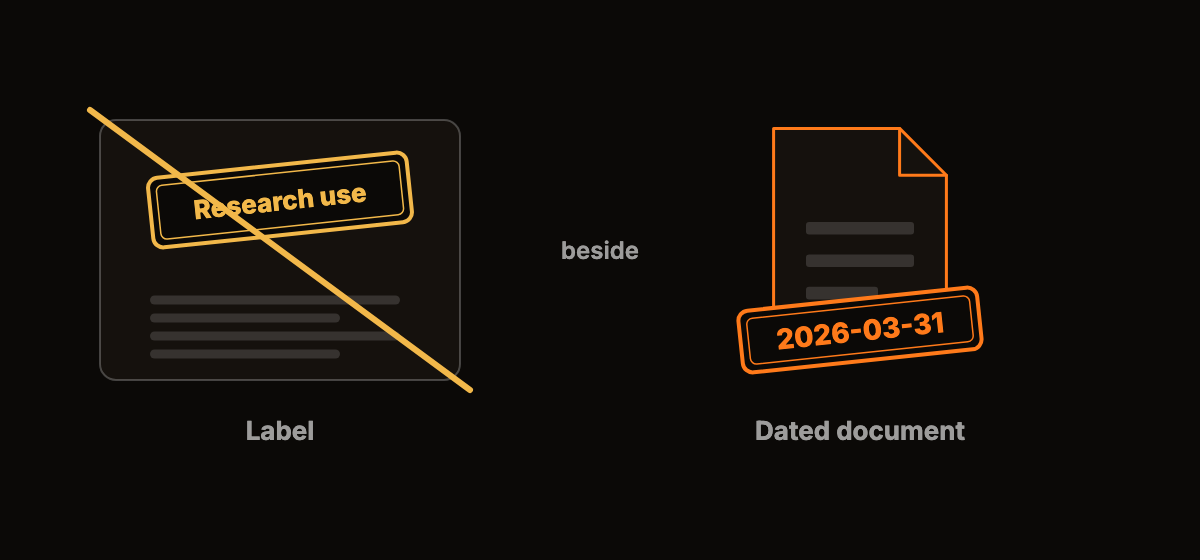
What the law says. FDA addressed this directly in letters to such sellers. In the FDA warning letter dated 2026-03-31, the agency says that despite labels stating "Research Use Only," evidence from the seller's website establishes the products are "intended to be drugs for human use." It calls them unapproved new drugs and says that introducing them into interstate commerce violates the Federal Food, Drug, and Cosmetic Act. The test is the one in 21 CFR 201.128: intended use can be shown by labeling claims, advertising, or written statements, whatever a disclaimer says.
What you can verify. In practice, very little. You can read what the seller says about itself. You cannot confirm the contents, because no pharmacy license, prescriber or dispensing record exists to check. The one document many sellers offer, a certificate of analysis, is covered in how to spot fake peptides; in short, the document comes from the seller or a lab the seller picked.
Red flags.
- A disclaimer on a page that otherwise reads like a drug store. FDA relied on exactly that mix in its letters, such as claims about weight, appetite or body composition on product pages. (FDA warning letter dated 2026-03-31)
- A diluent and syringes sold with the vial. FDA's August 2026 letters read that combination as evidence of an intent to prepare an injectable drug for people. (FDA warning letter dated 2026-08-24)
- Text summarizing laboratory studies beside a product. FDA says such passages count as claims about what the product does. (FDA warning letter dated 2026-08-24)
- Overseas shipment. FDA's page on personal importation calls bringing medicine in from abroad as illegal in most cases, even for one person's own use. (FDA personal importation page, current as of 2025-08-18)
Our page on research peptides explained takes a letter apart sentence by sentence.
Source type 4: Marketplaces and social sellers
Who sells. Resellers on online marketplaces, group chats, forums and social posts. Some ship from overseas. The seller may be a company, an individual or a drop-shipper, and the buyer often cannot tell which.
What the law says. A prescription drug sold without a prescription is an enforcement matter for FDA, and the importation rules apply when the shipment crosses a border. U.S. Customs and Border Protection reported on 2026-03-31 that it seized about 5,000 individual shipments of peptides from one shipper in China between December 2025 and 2026-03-25, "mis-manifested" as other goods. The same release says that the authenticity and safety of such peptides cannot be determined.
What you can verify. Almost nothing. FDA's GLP-1 page says illegally marketed semaglutide or tirzepatide sold online "may be counterfeit," could contain the wrong ingredients, and could contain too little, too much or no active ingredient.
Red flags.
- Payment only by app or transfer. We could not find an FDA statement on this point, so it is our editorial observation: a seller who avoids ordinary checkout is also avoiding the paper trail you would need if something goes wrong.
- Labels with spelling errors or wrong pharmacy addresses. FDA lists both as warning signs. (FDA GLP-1 page)
- A product that looks different from the last one. FDA's online-pharmacy page lists medicine that looks different or arrives damaged. (FDA consumer update)
- Seller pressure. Deep discounts and deadlines are on FDA's warning list. (FDA consumer update)
How a peptide gets from a lab to a person
Picture the path as a chain of handoffs. At each handoff, a document or a license either exists or does not. The lawful chain has more of them, which is why it is slower and costs more.
- A substance is made. A manufacturer makes the active ingredient. FDA's compounding pages say a compounder's bulk substances must come from an establishment registered with FDA and must be accompanied by a valid certificate of analysis.
- An approved drug or a compounder uses it. For an approved brand drug, the maker holds an FDA approval and a label. For a compounded drug, a pharmacy or an outsourcing facility uses a bulk substance that must meet FDA's conditions, as described in the 503A and 503B pages.
- A prescriber writes an order. Under section 503A, the compounded drug is made for an identified individual patient based on a valid prescription order.
- A pharmacy dispenses. A licensed pharmacist in a state-licensed pharmacy labels and ships it. The state board of pharmacy is the regulator you can look up.
- A person uses it under a prescriber's supervision. Follow-up belongs to the prescriber, which is why FDA lists no way to reach a licensed doctor after receiving medicine as a warning sign.
On the unlawful path, steps 3 and 4 are missing. A vial moves from a maker, which may be overseas, to a website or a reseller, to the buyer. No document connects the product in your hand to a license. That is the gap FDA's letters and CBP's seizure release describe.
This description is about how products move, not about how to use them. It contains no instructions, and none of our pages gives any.
Where to go next
Choose by the question you have.
- If you want the test for any seller, read how to choose a peptide company.
- If you want the legal picture, read is it legal to buy peptides online and research peptides explained.
- If you suspect a product or listing is not what it claims, read how to spot fake peptides.
- If you are looking for a store or clinic, read peptides near me.
- If you want the basics, read what is peptide therapy, what compounding means, which peptides are approved drugs, peptide side effects and peptide therapy cost.
- If you want to see how an online prescription works, read peptide prescription online.
- If you have one peptide in mind, read the guide for sermorelin, tirzepatide, semaglutide, BPC-157 or CJC-1295 and ipamorelin.
Sources
- FDA: How to buy medicines safely from an online pharmacy page current as of 2025-01-02, read 2026-10-07
- FDA: Compounding and the FDA, questions and answers page current as of 2025-09-16, read 2026-10-07
- FDA: Bulk drug substances used in compounding under section 503A page current as of 2026-05-14, read 2026-10-07
- FDA: Bulk drug substances used in compounding under section 503B page current as of 2025-01-07, read 2026-10-07
- 21 USC 353a (section 503A) read 2026-10-07
- FDA: Concerns with unapproved GLP-1 drugs used for weight loss page current as of 2026-10-01, read 2026-10-07
- FDA warning letter dated 2026-03-31 page current as of 2026-04-07, read 2026-10-07
- FDA warning letter dated 2026-08-24 read 2026-10-07
- 21 CFR 201.128 read 2026-10-07
- FDA: Personal importation page current as of 2025-08-18, read 2026-10-07
- CBP: Cincinnati CBP foils scheme to smuggle over 5,000 unapproved peptides release dated 2026-03-31, read 2026-10-07
FAQ
What are the main places to buy peptides online in the US?
Four kinds: a telehealth service with a licensed prescriber, your own doctor with a licensed pharmacy, "research use only" websites, and marketplaces or social sellers. Only the first two involve a prescription and a state-licensed pharmacy.
Why does it matter whether a pharmacy is state-licensed?
FDA lists a state board license as one of its safe signs for online pharmacies, and the state board is the regulator that oversees day-to-day pharmacy operations. A license is also something you can look up, which a vial's label is not.
Does a compounded peptide have the same status as an approved brand drug?
No. Compounded drugs are not FDA-approved, and FDA says it does not verify their safety, effectiveness or quality. Compounding by a licensed pharmacy for an individual patient is a lawful category.
Can a vial labeled for research be bought legally?
FDA's 2026-03-31 warning letter says a label of that kind does not decide what a product is intended for; the seller's own site does. The letters are addressed to sellers. For a buyer, the practical facts are that the product has no FDA approval and no pharmacy or clinician has reviewed the order.
Where do compounded peptides come from?
From a pharmacy or outsourcing facility that uses a bulk substance meeting FDA's conditions, made for an identified patient on a valid prescription in the 503A case. The bulk substance comes from an FDA-registered establishment with a certificate of analysis.
Does this site sell peptides?
No. We are an editorial team that reads FDA pages and writes down what they say. We feature one service through an affiliate link, and we never link to sellers of unapproved products.
Not medical advice. See the medical disclaimer.