Quick answer: A compounded drug is made by a pharmacy or outsourcing facility to a prescriber's order, instead of coming from a manufacturer's approved product. Compounded medications are not FDA-approved. FDA says it does not verify their safety, effectiveness or quality. Section 503A covers state-licensed pharmacies filling individual prescriptions, and section 503B covers FDA-registered outsourcing facilities. A peptide can be compounded only within the limits FDA sets for its ingredient.
Compounding is lawful under defined conditions, and plenty of legitimate prescriptions depend on it. What this page explains is where the limits sit, so you can ask better questions. Some links on this page are affiliate links, and we may earn a commission if you use them. A prescription is a clinician's decision, not a feature you can purchase.
What compounding is, and when FDA says to use it
Compounding means a pharmacist, or in some cases a physician, combines or alters ingredients to prepare a medicine for one patient. FDA's questions-and-answers page (current as of 2025-09-16, read 2026-10-07) states plainly that compounded drugs are not FDA-approved, and that because of this FDA "does not verify the safety, effectiveness or quality" of them.
FDA adds that compounded drugs should only be used for patients whose medical needs cannot be met by an FDA-approved drug. That is FDA's stated reason compounding exists: a gap in what approved products can do for a particular person. It is not a general alternative to approved products.
FDA also cautions that weak compounding practice can lead to quality failures, including contamination and a product with the wrong amount of active ingredient. And it notes that consumers who buy compounded drugs from online pharmacies and telehealth platforms "may not know the identity of the compounder." That last point is why this page exists. When a peptide arrives from a service, the first question is who made it.
503A vs 503B in plain words
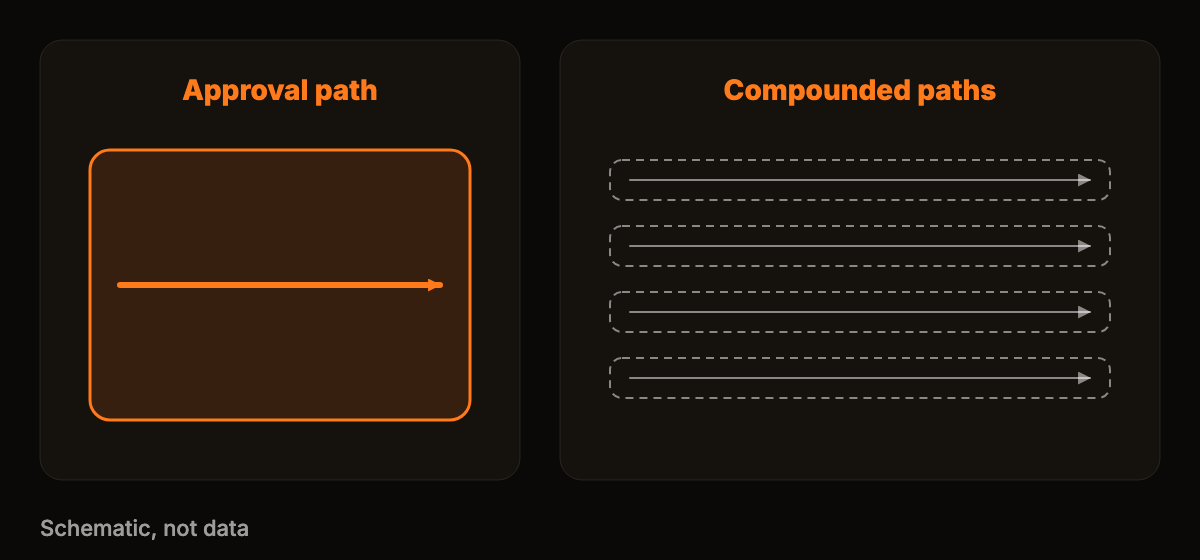
Two sections of the Federal Food, Drug, and Cosmetic Act set the rules. Both are about compounded drugs, and neither is an FDA approval.
| Section 503A | Section 503B | |
|---|---|---|
| Who compounds | A licensed pharmacist in a state-licensed pharmacy or federal facility, or a licensed physician | An outsourcing facility registered with FDA |
| Basis for the drug | Compounded for an identified individual patient based on a valid prescription order | Made under the outsourcing-facility rules, inspected by FDA on a risk-based schedule |
| Good manufacturing practice rules (CGMP) | Not subject to CGMP, per FDA's Q&A | Subject to CGMP, per FDA's Q&A |
| Day-to-day oversight | State boards of pharmacy have primary day-to-day oversight | FDA inspects, by FDA's description |
| Bulk ingredient rules | The ingredient must meet a USP or NF monograph, be a component of an FDA-approved drug, or appear on FDA's 503A bulks list | The ingredient must be on FDA's 503B bulks list for clinical need, or the drug must be on FDA's shortage list |
| Ingredient paperwork | Valid certificate of analysis; maker registered with FDA | Certificate of analysis and registered maker also required |
| Adverse event reporting | State-licensed pharmacies that are not outsourcing facilities are not required to report to FDA | FDA's wording exempts only pharmacies "that are not outsourcing facilities" from submitting reports |
| FDA approval of the drug | None. Compounded medications are not FDA-approved | None. Compounded medications are not FDA-approved |
As of 2026-10-07. Sources: FDA compounding Q&A (current as of 2025-09-16); FDA 503A page (current as of 2026-05-14); FDA 503B page (current as of 2025-01-07); 21 U.S.C. 353a; FDA GLP-1 page (current as of 2026-10-01).
Three points in plain terms. A 503A pharmacy makes a medicine for a named person from a prescription, and the state board of pharmacy is the usual watchdog. A 503B facility is registered with FDA and has to follow manufacturing rules, but it is still not producing an approved drug. And FDA does not approve or license either kind of facility, which its telehealth marketing page (current as of 2026-06-15) says directly. "FDA-registered" describes a registration, not an approval.
One more limit from the same Q&A: biological products are not eligible for the 503A and 503B exemptions. The page does not name peptides, so we draw no conclusion about any specific one. Chain length is part of what separates a peptide from a protein, as what is peptide therapy explains.
The interim categories FDA uses for bulk ingredients
When a compounder wants to use a bulk substance that is not in an approved drug and not in a USP or NF monograph, FDA has a list process. In the meantime, an interim policy sorts nominated substances into categories. FDA's 503A page (current as of 2026-05-14) describes them this way:
- Category 1: substances that may be eligible for the 503A bulks list, where FDA says it does not intend to take action if the guidance conditions are met.
- Category 2: substances where FDA "has identified significant safety risks," and where FDA would consider taking action against a compounder.
- Category 3: substances nominated with insufficient supporting information, which are not eligible for the Category 1 policy.
How some well-known names sit in FDA's documents, as read on 2026-10-07:
- Sermorelin acetate appears in the 503B Category 1 list (document updated 2025-03-21) with a mark FDA uses for components of FDA-approved drugs. It is not in the 503A category document (updated 2026-05-14). FDA's wording on whether a 503A pharmacy may compound it by another route was not found. See buy sermorelin online.
- Ipamorelin acetate is in the 503B Category 2 list; FDA's safety-risks page (current as of 2026-04-22) shows it with an entry added 2023-09-29 and a stated immunogenicity risk.
- BPC-157 and CJC-1295 appear on that page under substances "previously in category 2" that were withdrawn by the nominators. FDA still prints safety concerns for them. Neither is listed in any category in the 503A or 503B documents. We do not describe either as currently in Category 2.
- Retatrutide is not on the category lists. FDA says it "cannot be used in compounding under federal law" (GLP-1 page, current as of 2026-10-01).
- Semaglutide and tirzepatide are not on the 503B bulks list or the shortage list per FDA's page entry dated 2026-04-01. FDA announced a proposal on 2026-04-30 to exclude semaglutide, tirzepatide and liraglutide from the 503B bulks list. The comment period was extended to 2026-07-30, and we found no final action as of 2026-10-07.
Why "FDA-registered" and "licensed" are not "approved"
Marketing for compounded products often leans on the facility's credentials. The words that matter are exact.
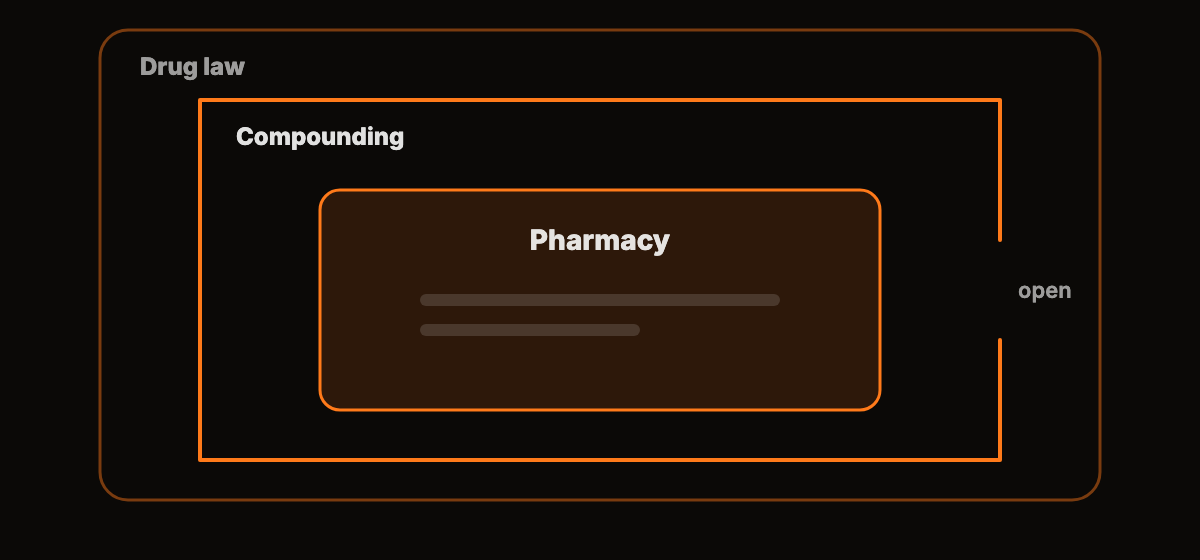
FDA's telehealth page tells companies not to call a compounded drug generic or "the same as" a drug approved by FDA, and not to claim it is sourced from an FDA-approved or FDA-licensed pharmacy, because FDA does not approve or license any facility. On 2026-03-03 FDA announced it had sent warning letters to 30 telehealth companies over false or misleading claims about compounded GLP-1 drugs, including claims that imply sameness with approved products.
A state license says a pharmacy may operate in that state. An FDA registration says an outsourcing facility has registered. Neither tells you that the finished product was reviewed for safety or effectiveness, because compounded medications are not FDA-approved.
What Whoosh says about its compounding
Whoosh Wellness says on its FAQ and product pages that all of its protocols are compounded by licensed 503A/503B US pharmacies and that every batch is third-party tested. Its terms say compounded medications are not reviewed or approved by FDA for safety or efficacy. Its home page says they are made in "FDA-registered facilities but are not FDA-approved."
Its pages do not say which pharmacy is a 503A pharmacy and which is a 503B facility, or which one makes a given product. No testing lab is named and no certificate of analysis is shown on the pages we read. We cannot check either claim. As stated by Whoosh (read 2026-10-07), it offers compounded sermorelin, semaglutide and tirzepatide, plus NAD+, glutathione and a topical GHK-Cu product; it does not offer BPC-157, CJC-1295, ipamorelin, tesamorelin or retatrutide.
If you decide to look at Whoosh, the intake is how you start. The service says a licensed provider reviews each intake and prescribes only if it is right for you. The process, the named pharmacy and the five states its pharmacy is not licensed in are covered in peptide prescription online, and the full read of its pages is in the Whoosh Wellness review.
A licensed physician decides whether a prescription is appropriate, so there is no promise of approval.
Questions to ask your prescriber and pharmacy
Ask these in writing, and keep the replies.
- Is this a brand-name product or a compounded medication? If compounded, does the paperwork say it is not FDA-approved?
- Which pharmacy or outsourcing facility makes it, and is it a 503A pharmacy or a 503B facility?
- Where is the pharmacy licensed, and can I find it in my state board's database? (FDA's BeSafeRx tool is the starting point.)
- What is the ingredient's status in FDA's interim categories, if it is on a list?
- Is there an approved product that could meet my medical needs, and why is that not the option here?
- How do I report a problem, and who answers questions after the product arrives?
The first and fifth questions follow FDA's own wording about when compounding is appropriate. The sixth matters because FDA says adverse events for compounded products are likely underreported, since pharmacies that are not outsourcing facilities do not have to submit them. The wider picture of lawfulness is in is it legal to buy peptides online.
Sources
- FDA: Compounding and FDA, questions and answers page current as of 2025-09-16, read 2026-10-07
- FDA: Bulk drug substances used in compounding under section 503A page current as of 2026-05-14, read 2026-10-07
- FDA: Bulk drug substances used in compounding under section 503B page current as of 2025-01-07, read 2026-10-07
- FDA: 503A bulk drug substances category document updated 2026-05-14, read 2026-10-07
- FDA: 503B bulk drug substances category document updated 2025-03-21, read 2026-10-07
- FDA: Certain bulk drug substances that may present significant safety risks page current as of 2026-04-22, read 2026-10-07
- FDA: Concerns with unapproved GLP-1 drugs used for weight loss page current as of 2026-10-01, read 2026-10-07
- FDA: Telehealth companies, what to know when promoting compounded drugs page current as of 2026-06-15, read 2026-10-07
- FDA press release: FDA warns 30 telehealth companies dated 2026-03-03, read 2026-10-07
- FDA press release: proposal to exclude semaglutide, tirzepatide and liraglutide from the 503B bulks list dated 2026-04-30, read 2026-10-07
- Cornell LII: 21 U.S.C. 353a read 2026-10-07
- Whoosh Wellness: FAQs read 2026-10-07
- Whoosh Wellness: Terms and conditions read 2026-10-07
FAQ
What are compounded peptides?
They are peptide-containing medicines made by a pharmacy or outsourcing facility to a prescriber's order. Compounded medications are not FDA-approved, and FDA says it does not verify their safety, effectiveness or quality.
What is the difference between 503A and 503B?
A 503A pharmacy compounds for an identified individual patient from a prescription, under state board oversight. A 503B outsourcing facility is registered with FDA, follows manufacturing rules and is inspected by FDA on a risk-based schedule. Neither makes an FDA-approved drug.
Is a compounded peptide the same as the approved brand?
FDA says no company should describe a compounded drug as "the same as" an approved drug, and it says compounded drugs are not the same as generic drugs. Ask what the label says.
Can any peptide be compounded?
No. FDA limits which bulk ingredients may be used, and it says retatrutide cannot be used in compounding under federal law. BPC-157, CJC-1295 and ipamorelin have their own entries in FDA's documents, covered above.
Does "FDA-registered" mean FDA-approved?
No. FDA says it does not approve or license any facility. A registration is not an approval of the product.
Who oversees a compounding pharmacy?
For a 503A pharmacy, FDA says the state board of pharmacy has primary day-to-day oversight. FDA inspects outsourcing facilities on a risk-based schedule.
Does Whoosh use compounded products?
Yes, as stated by Whoosh, it uses licensed 503A and 503B pharmacies, and its pages do not say which one makes a given product. Whoosh's own terms say its compounded medications are not approved by FDA.
Not medical advice. See the medical disclaimer.